Ever dropped a clever double meaning into a sentence and then added “pun intended” right after it? You’re not alone. It’s one of the most common phrases in everyday English, used in conversations, captions, headlines, and even boardroom small talk. But what does it actually mean, where does it come from, and when should you (or shouldn’t you) use it?
This guide breaks down the pun intended meaning in plain English, walks through real examples, explains the different types of puns behind the phrase, and shows you exactly how and when to use it. Without sounding forced or overdone.
What Does Pun Intended Mean?
Definition
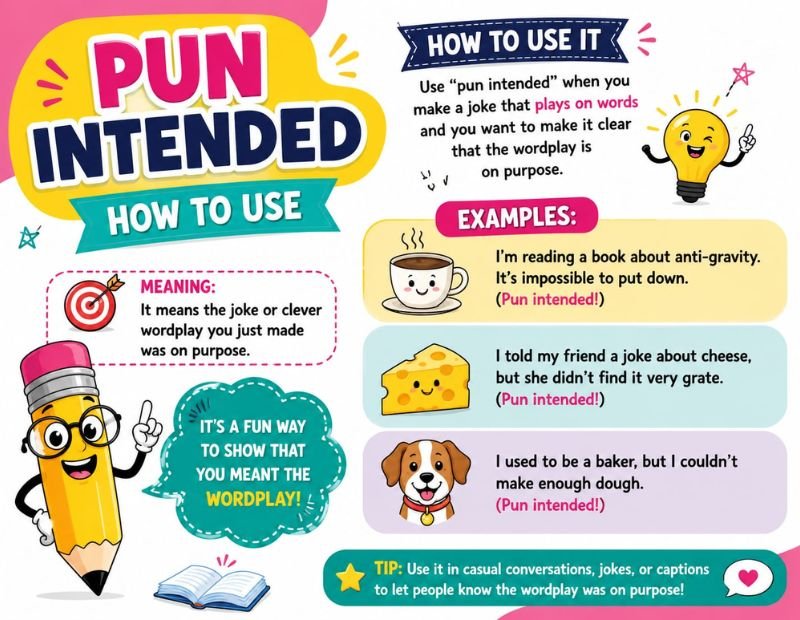
It is a phrase used right after a sentence containing a play on words. It signals to the listener or reader that the double meaning wasn’t accidental. The speaker meant to be witty.
In simple terms: a pun is the joke, and “pun intended” is the wink that confirms the joke was on purpose.
Example:
“I’m reading a book on anti-gravity. It’s impossible to put down .”
Here, “put down” plays on two meanings: stopping reading a book, and literally lowering it. It makes sure the audience catches the wordplay instead of missing it.
Read Also This Blog: Funny Pun Examples
Why it Is Used?
People use the phrase for a few practical reasons:
- To highlight humor that might otherwise slip past the listener
- To clarify intent, so the audience knows the double meaning was deliberate, not a slip of the tongue
- To add personality to writing, speech, or social media captions
- To soften an awkward or blunt phrase by framing it as a joke
What Is a Pun? Understanding Wordplay First
A pun is a form of wordplay that uses a word with multiple meanings, or two similar-sounding words, to create a humorous or clever effect. Puns rely on ambiguity the same word or phrase can be read two different ways at once.
Another name for a pun is paronomasia, a term borrowed from Greek that roughly translates to “calling something by a slightly altered name.”
Types of Puns
Puns generally fall into a few recognizable categories:
| Type of Pun | How It Works | Example |
|---|---|---|
| Homophonic | Uses words that sound alike but have different meanings/spellings | “I used to be a baker, but I couldn’t make enough dough.” |
| Homographic | Uses words spelled the same but with different meanings | “Time flies like an arrow; fruit flies like a banana.” |
| Homonymic | Uses words identical in both spelling and sound | “I made a joke during the Zoom call, but it wasn’t remotely funny.” |
| Compound | Stacks two or more puns into a single line | “Did you hear about the lumberjack who couldn’t hack it? They gave him the axe.” |
Homophonic puns tend to work best out loud, since the humor lives in the sound. Homographic puns, on the other hand, often land better in writing, since the joke depends on seeing the identical spelling.
How it Is Used in Sentences?
Placement
“Pun intended” almost always appears immediately after the punny word or phrase, often set off with a dash, comma, or parentheses. This placement keeps the joke fresh in the reader’s mind before revealing that it was deliberate.
Common formats include:
- “…(pun intended).”
- “…— pun intended.”
- “…pun intended, of course.”
Pun Intended Meaning in English Usage
In everyday English, “pun intended” functions almost like a verbal nudge or an emoji. It doesn’t add new information, but it adds tone. It tells the reader, “I know what I just did there.”
Ten Practical Examples
- “The math teacher was great at solving problems.”
- “This bakery really takes the cake, pun intended.”
- “I stayed up all night wondering where the sun went. Then it dawned on me “
- “The electrician was shockingly good at his job, pun intended.”
- “She had a photographic memory but never developed it .”
- “The stadium got hot after the match, so the fans left. “
- “I’m on a seafood diet. I see food and I eat it .”
- “The calendar’s days were numbered .”
- “I used to be addicted to soap, but I’m clean now .”
- “A plant grower’s success is rooted in patience.”
Pun Intended vs. No Pun Intended: What Is the Difference?
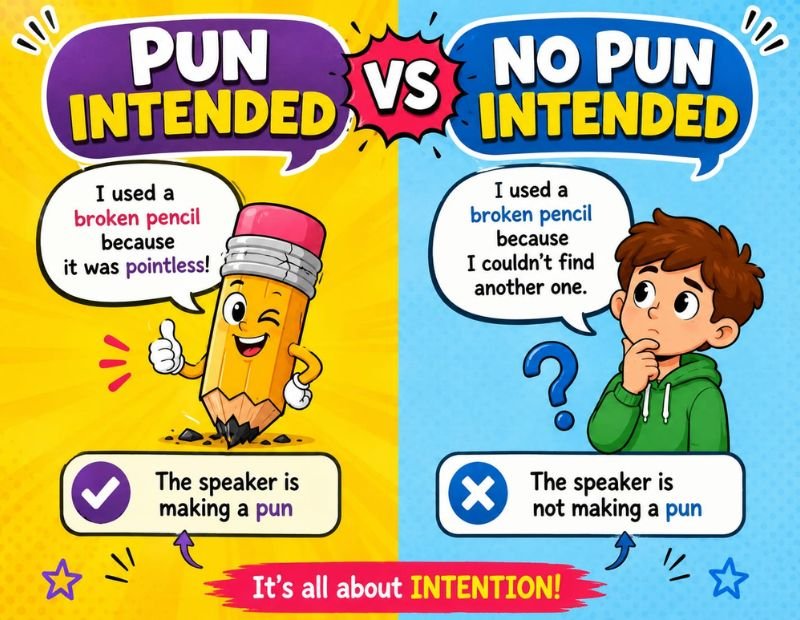
This is where a lot of people get confused, so here’s the simple breakdown.
- “Pun intended” means the double meaning was created on purpose, and the speaker wants credit for the joke.
- “No pun intended” means the sentence could be read as a pun, but the speaker didn’t mean it that way. They want you to take the plain, literal meaning instead.
No Pun Intended Example
“The pilot’s career really took off, no pun intended.”
Here, the speaker is pointing out that “took off” has an obvious aviation connection, but insists they weren’t trying to be clever. Ironically, saying “no pun intended” often draws just as much attention to the wordplay as saying “pun intended” would.
Quick Comparison
| Phrase | Meaning | Purpose |
|---|---|---|
| Pun intended | The wordplay was deliberate | To claim credit for the joke |
| No pun intended | The wordplay was accidental (or the speaker wants to downplay it) | To clarify the literal meaning was intended |
How to Use?
What Does “Pun Intended, Perhaps” Mean?
Adding “perhaps” softens the phrase into a more sarcastic or self-aware tone, as if the speaker is teasing themselves for how obvious or corny the pun was. It’s often used ironically in writing or online posts.
Why Do People Say Pun Intended?
1. Social Signaling of Humor Saying “pun intended” tells others that you’re aware of your own wit. It’s a small way of showing personality in conversation or writing.
2. Avoiding Confusion Not every reader catches wordplay instantly. The phrase acts as a signpost, making sure the joke actually lands.
3. Enhancing Wit It adds a layer of self-aware humor, which can make even a simple pun feel more polished or intentional.
4. Building Rapport Shared laughter over wordplay even a groan worthy one can make conversations feel warmer and more relaxed, especially in casual or professional icebreakers.
Can a Pun Be Unintentional?
Yes. Language is full of double meanings, and sometimes a sentence accidentally creates a funny or awkward second interpretation without the speaker noticing. This is exactly why “no pun intended” exists to clarify that the double meaning wasn’t planned.
Is Saying Pun Intended Rude or Clever?
It depends entirely on context. Used sparingly and in the right setting, it reads as clever and lighthearted. Overused, it can come across as try-hard or distracting.
Appropriate Contexts
- Casual conversations with friends or coworkers
- Social media captions and comments
- Light, informal writing like blog posts or emails
- Icebreakers in meetings or presentations
Situations to Avoid
Overusing It Sprinkling “pun intended” into every other sentence quickly turns charming wordplay into an exhausting habit.
Using It Without a Real Pun If there’s no actual double meaning in the sentence, tacking on “pun intended” just confuses the reader.
Using It in Serious Writing Formal reports, academic papers, legal documents, and professional emails to clients are generally not the place for wordplay or humor tags.
Misunderstanding Double Entendre A double entendre usually carries a suggestive or risqué second meaning, while a standard pun is simply playful. Mixing the two up can lead to awkward or inappropriate phrasing in the wrong setting.
Explore More Clever Wordplay and Funny Reads
If you enjoyed learning about “pun intended,” you might also like exploring:
- Classic dad jokes and one-liners
- Shakespearean puns and wordplay in literature
- The difference between puns and double entendres
- Homophone-based riddles and brain teasers
Conclusion
The phrase “pun intended” is a small but powerful tool in everyday language. It confirms that a clever double meaning was deliberate, helps humor land more clearly, and adds a touch of personality to writing and speech. Used at the right moment, it turns a simple wordplay into a shared joke between writer and reader. Used too often, it can lose its charm. The key is balance: drop it in when the pun deserves the spotlight, and let the rest of your writing speak for itself — pun very much intended.
Frequently Asked Questions
What does “pun intended” mean in a text message?
It means the sender deliberately used a word with a double meaning and wants the reader to notice the joke.
Is “pun intended” grammatically correct?
Yes, it’s a short, accepted phrase in English used to mark deliberate wordplay, typically as a parenthetical remark.
What’s the opposite of “pun intended”?
No, it is the opposite. it signals that a possible double meaning was accidental, not deliberate.
Can “pun intended” be used in formal writing?
It’s best avoided in formal or academic writing, since it introduces a casual, humorous tone that clashes with professional style.
Where did the phrase “pun intended” come from?
It grew out of everyday spoken English as a natural way to flag intentional wordplay, especially once puns became a recognized comedic device in literature and speech.
Is a pun the same as a double entendre?
No. A pun is general wordplay with a double meaning, while a double entendre specifically carries a second, often suggestive, meaning.