

Meta title: Puns in Creative Writing: 25+ Examples, Types and Writing Tips
Meta description: Learn how to use puns in creative writing. Get 25+ examples, 18 pun types, Hindi, Urdu and English topic ideas, and tips for kids, food, gaming and science puns.
A pun can turn a flat sentence into one that readers remember. It can make a character feel sharp, a headline feel fresh, or a poem feel layered. That is why puns in creative writing remain a favorite tool for novelists, poets, copywriters, and screenwriters.
This guide explains what puns are, how they work in literature, and how to write them well. You will find 18 pun types with examples, topic ideas in Hindi, Urdu, and English, and practical advice for writing puns for kids, adults, teachers, gamers, and more. Every example is original and ready to inspire your own work.
What Are Puns In Creative Writing?
Puns in creative writing are deliberate plays on words that use double meanings or similar sounds to create humor, surprise, or depth. The writer picks a word that can be read in two ways, then builds a sentence where both readings fit.
Example: “The librarian was booked solid, so she decided to turn over a new leaf.” Here “booked” and “leaf” connect scheduling and books at once.
Creative writers use puns in stories, poems, scripts, ads, captions, and titles. The technical word for a pun is paronomasia.
Read Also This Blog: Puns Literary Techniques
What Is A Pun In Literature?
In literature, a pun is a figure of speech that uses polysemy (one word, many meanings), homophones (same sound), or near sounds to create two readings in a single line. It sits in the family of wordplay, next to irony, oxymoron, and double entendre.
Classic authors such as Shakespeare, Dickens, Wilde, and Joyce used puns for more than laughs. In their pages, a pun can reveal a character’s wit, hint at a secret, or add a grim twist to a serious scene.
In Hindi poetry, this device appears as shlesh alankar, where one word carries more than one meaning. Urdu poetry has a close cousin called ihaam, where a word suggests a second, hidden meaning.
How To Write Puns In Creative Writing?
Follow these steps to build a pun from scratch.
- Pick a topic. Choose a subject such as coffee, school, or space.
- List related words. Write every term linked to the topic.
- Find double meanings. Look for words with a second sense or a similar sounding partner.
- Build the setup. Write a sentence where the first meaning feels natural.
- Place the twist late. Put the pun word near the end for the best surprise.
- Read it aloud. If it does not sound right, change the words.
- Trim the extras. Cut anything that explains the joke.
- Test it on a reader. A good pun gets a smile or a groan within seconds.
Purpose Of Puns In Creative Writing
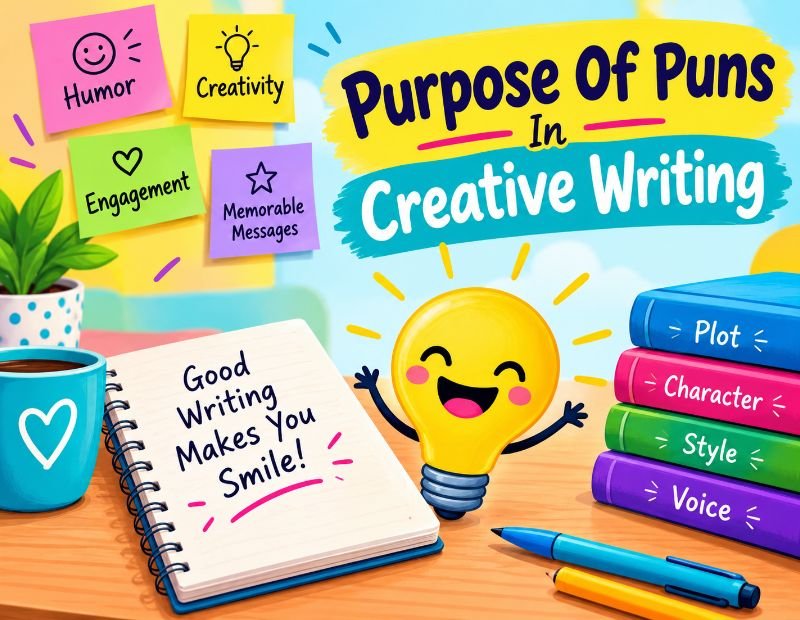
Puns do many jobs in a story, poem, or script.
- Create humor that relieves tension.
- Build character by showing who is witty, nervous, or sly.
- Add layers of meaning for readers who look closely.
- Support themes by repeating a key idea in a new form.
- Hide Easter eggs or hints about the plot.
- Make titles and headlines memorable.
- Connect with readers through shared language and culture.
Characteristics Of Puns In Creative Writing
Good puns share a recognizable set of traits.
- Double meaning: two readings live in one phrase.
- Economy: the best puns are short and tight.
- Surprise: the second meaning arrives after the first.
- Context: the setting makes both meanings believable.
- Sound or spelling link: the two meanings are close enough to connect.
- Playful tone: even dark puns feel light on the surface.
- Audience awareness: the reader must know both meanings.
Effects Of Puns In Creative Writing
| Effect | What The Reader Feels | Where It Works Best |
|---|---|---|
| Laughter or groan | Amusement | Jokes, comedy scripts |
| Memorability | The line sticks | Headlines, slogans, titles |
| Delight | A small “aha” moment | Poetry, clever fiction |
| Character insight | The speaker feels real | Dialogue, screenplays |
| Tension relief | Calm after stress | Thrillers, drama |
| Irony | A sharper second meaning | Satire, essays |
| Engagement | Curiosity to read on | Blogs, social posts |
Too many puns can tire the reader. One strong pun in a paragraph is usually enough.
List Of 18 Puns In Creative Writing
Here are 18 pun forms with a quick definition and a fresh example for each.
| No. | Pun Type | How It Works | Example |
|---|---|---|---|
| 1 | Homophonic | Words sound alike | “The baker had a loaf affair with his oven.” |
| 2 | Homographic | Same spelling, different meaning | “The farmer decided to produce produce.” |
| 3 | Homonymic | Same sound and spelling | “The tennis coach served a fine reputation.” |
| 4 | Compound | Several puns in one line | “The gardener leafed the office to branch out and root for himself.” |
| 5 | Recursive | Needs the first joke to understand the second | “To understand recursion, first understand a recursion pun.” |
| 6 | Visual | Image carries the double meaning | A bread logo shaped like a smiling sun that says “Rise and Shine Bakery.” |
| 7 | Idiom twist | Changes a familiar phrase | “Time flies when you’re having a tick tock show.” |
| 8 | Portmanteau | Blends two words | “Hangry: the mood of a very hungry writer.” |
| 9 | Double entendre | Hidden second meaning | “The cook said the dish needed a firm hand.” |
| 10 | Tom Swifty | Adverb matches the quote | “‘I dropped the pencil,’ he said bluntly.” |
| 11 | Charactonym | A name hints at personality | A detective named Constance Clue. |
| 12 | Title pun | The title plays on a known phrase | A baking memoir called Dough Not Disturb. |
| 13 | Headline pun | A news title uses wordplay | “Library Fire Leaves Readers Burned Up.” |
| 14 | Rhyming pun | Rhyme supports the twist | “A snail’s life is slow, but it knows how to go with the flow.” |
| 15 | Bilingual pun | Mixes two languages | “Safar karna hai to suffer bhi seekho.” |
| 16 | Situational pun | The scene itself carries the joke | A clockmaker arrives late to his own retirement party. |
| 17 | Dialogue pun | A character speaks the wordplay | “‘I’m board,’ said the plank.” |
| 18 | Slogan pun | Brand copy plays on a phrase | “Our coffee is brew tiful.” |
10 Famous Hindi Topics For Puns In Creative Writing
Hindi wordplay is rich because so many words carry several meanings. Here are ten popular topics with a sample line each.
| No. | Topic | Wordplay Angle | Sample Line |
|---|---|---|---|
| 1 | Chai | patti means leaf and card | “Chai ki patti aur teen patti, dono mein kismat ka khel hai.” |
| 2 | Mehngai | daam (price) and dam (breath) | “Sabzi ke daam ne sabka dam nikal diya.” |
| 3 | Diwali | diya means lamp and gave | “Usne mujhe ek diya diya.” |
| 4 | Time | kal means yesterday and tomorrow | “Kal ka kaam kal par mat chhodo, par kaun sa kal?” |
| 5 | Mango season | aam means mango and common | “Garmi mein aam bhi khaas ho jata hai.” |
| 6 | Holi | rang mein bhang | “Holi ka maza tabhi hai jab rang mein bhang na pade.” |
| 7 | School | kaksha means class and orbit | “Chandrama bhi apni kaksha mein hi anushasan seekhta hai.” |
| 8 | Bollywood | hit means success and strike | “Film hit thi, isliye hero ne villain ko bhi hit kiya.” |
| 9 | Water | paani means water and honor | Classic poets used paani to mean both water and dignity. |
| 10 | Mithai | sweet talk and sweets | “Meethi baat karne wale ke paas mithai nahi, zubaan hoti hai.” |
10 Famous Urdu Topics For Puns In Creative Writing
Urdu poetry loves ihaam, so these topics suit both light jokes and graceful verse.
| No. | Topic | Wordplay Angle | Sample Line |
|---|---|---|---|
| 1 | Chand | chand means moon and few | “Chand logon ne chand dekha.” |
| 2 | Shama and Parwana | jalna means burn and envy | “Shama jali to parwana bhi jal gaya.” |
| 3 | Mushaira | daad sounds like “dad” | “Shayar ne daad maangi, beta bola, Dad, aap hi best hain.” |
| 4 | Roza | roza and rozana | “Roza rakhna rozana mushkil nahi, agar niyyat saaf ho.” |
| 5 | Biryani | raita phailana | “Dawat mein raita kam pada to mehmanon ne raita phaila diya.” |
| 6 | Cricket | chhakke chhootna | “Chhakka laga to bowler ke chhakke chhoot gaye.” |
| 7 | Dil | dil lagana | “Dil lagana aasan hai, dil ka laga rehna mushkil.” |
| 8 | Safar | safar sounds like suffer | “Safar karna hai to suffer karna bhi seekho.” |
| 9 | Bazaar | bhaav khana | “Dukaandaar ne bhaav bataya, aur gahak bhaav khane lage.” |
| 10 | Kitab | page and warq | “Kitab bandh hui to kahani ka har warq so gaya.” |
10 Famous English Topics For Puns In Creative Writing
| No. | Topic | Sample Pun |
|---|---|---|
| 1 | Books | “My novel about glue is a real page stuck.” |
| 2 | Coffee | “I like my mornings like my coffee: espresso and quick.” |
| 3 | Weather | “The forecast was cloudy, but my mood had a silver lining.” |
| 4 | Music | “The pianist stayed calm because he knew the right key.” |
| 5 | Sports | “The golfer wore two pairs of pants in case he got a hole in one.” |
| 6 | Travel | “The pilot’s career really took off.” |
| 7 | Technology | “The laptop got cold because it left its Windows open.” |
| 8 | Money | “The banker lost interest in the loan.” |
| 9 | Fashion | “The tailor’s career was a perfect fit.” |
| 10 | Time | “The clock shop was running out of time, but business was ticking.” |
Bad Puns In Creative Writing
Bad puns are deliberately groan worthy. The trick is to be obvious and proud of it. Use a long setup, an easy twist, and a deadpan voice.
Example: “I told a joke about construction, but I’m still working on it.”
In fiction, a character who tells bad puns often reads as warm, nervous, or lovably awkward.
Happy Puns In Creative Writing
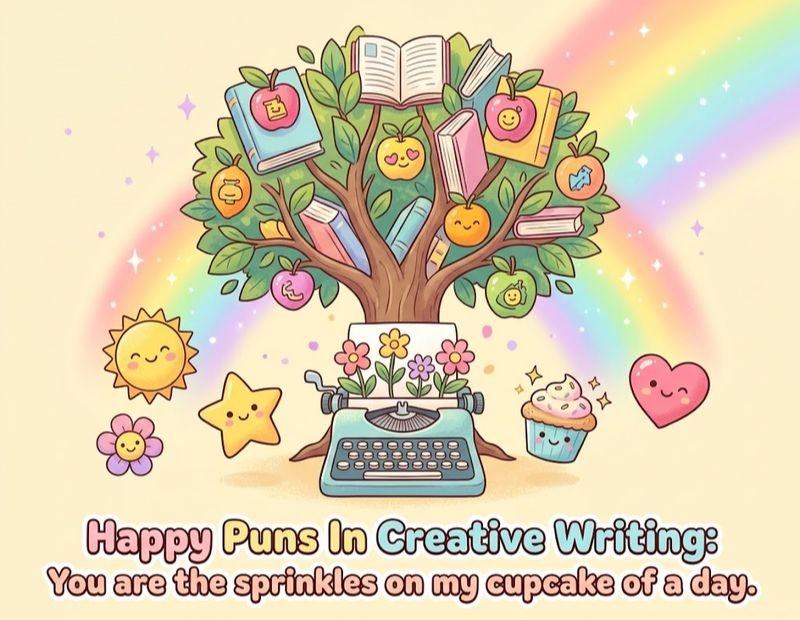
Happy puns lift the mood with soft sounds and friendly images. Use bright words like sun, smile, and bloom.
Example: “You are the sprinkles on my cupcake of a day.”
These suit cards, captions, children’s stories, and uplifting blog posts. Avoid sharp or sarcastic angles.
Classic Puns In Creative Writing
Classic puns use simple homonyms and a question and answer format. They are short, clean, and easy to repeat.
Example: “Why was the math book sad? It had too many problems.”
These work well in school readers, joke books, and light comedy.
Traditional Puns In Creative Writing
Traditional puns draw on proverbs, folk sayings, and old stage comedy. The main tool is the idiom twist, delivered with a formal voice.
Example: “A stitch in time saves nine, but a stitch in rhyme saves the poet.”
Poetry anthologies and theater scripts often use this style.
Modern Puns In Creative Writing
Modern puns live in memes, reels, headlines, and short captions. They favor portmanteaus, tech terms, and pop culture references.
Example: “My phone and I are in a long distance relationship because the charger is across the room.”
Keep them under twenty words and place the twist at the very end.
Animals Puns In Creative Writing
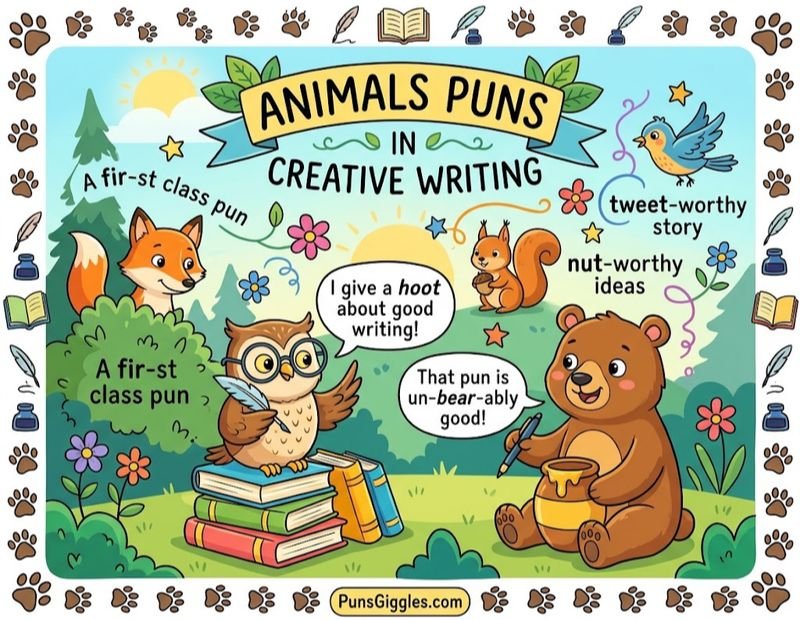
Animal puns rely on sounds, habits, and anthropomorphism.
Example: “The owl got promoted because he gave a hoot about his work.”
Try animal noises like purr, moo, and quack. Add behaviors such as hopping or hibernating to widen your idea pool.
Festivals Puns In Creative Writing
Festival puns use shared symbols that readers know at once, such as lights, lanterns, colors, and feasts.
Example: “Our Diwali party was a real light show, and nobody left in the dark.”
Respect the meaning of each festival and keep the tone kind and inclusive.
Puns In Creative Writing For Kids
Kids enjoy simple words and silly sounds. Use short riddles, basic homophones, and picture friendly words.
Example: “What do you call a bear with no teeth? A gummy bear.”
Keep sentences short, and keep the answer easy to say aloud.
Puns In Creative Writing For Adults
Adult puns can use irony, workplace themes, and layered references.
Example: “My calendar is so full that even my free time has a deadline.”
Dry delivery works well. Know your audience, and avoid crossing into offensive territory.
Puns In Creative Writing For Teachers
Teacher puns connect to chalk, grades, homework, and lessons. They also help students remember grammar and vocabulary.
Example: “The grammar teacher never argued, because she always had the last word.”
Try puns as warm ups, board starters, or fun classroom posters.
Puns In Creative Writing Food
Food puns thrive on menus, packaging, and recipe blogs. Ingredient names and cooking verbs give you endless material.
Example: “This pasta is un-fork-gettable.”
Pair the pun with a sensory word like crisp, spicy, or creamy to boost appeal.
Puns In Creative Writing For Medical
Medical puns use anatomy terms, hospital scenes, and symptoms. Keep them gentle and never mock real illness.
Example: “The surgeon’s jokes were great, but they were a little too cutting.”
They suit health awareness posts, staff room humor, and light educational content.
Puns In Creative Writing Celebrations
Birthdays, weddings, and graduations all welcome wordplay. Add a name or shared memory to make the pun feel personal.
Example: “Another year older, and you are still the cream of the cake.”
Toast style phrasing and warm homophones work best.
Puns In Creative Writing For Gaming
Gaming puns use terms like respawn, lag, loot, and boss fight. Gamers enjoy insider language, so get the terms right.
Example: “I’d tell you my favorite level, but I don’t want to spoil the save point.”
Gaming blogs, streams, and channel names use these puns all the time.
Puns In Creative Writing Science
Science puns use words that carry both technical and everyday meanings, such as matter, energy, cell, and element.
Example: “The chemist’s jokes had no reaction, so he decided to find a better solution.”
Add a small clue so general readers can still enjoy the joke.
Pro Tips To Write Better Puns
- Keep a pun notebook. Save idioms, homophones, and odd words you meet.
- Use a rhyming dictionary to hunt for sound alikes.
- Try place names. Many city names break into funny phrases.
- Use puns in titles first. A title is the safest spot for wordplay.
- Match tone to genre. Comedy can handle many puns, while serious drama needs very few.
- Edit ruthlessly. If the pun needs a footnote, rewrite it.
- Know the cultural context. A pun in Hindi or Urdu may not land in English, and the other way around.
Common Mistakes To Avoid
- Stuffing too many puns into one scene.
- Using meanings your reader does not know.
- Explaining the joke after you tell it.
- Confusing puns with malapropisms, which are accidental word errors.
- Ignoring the tone of the piece.
Conclusion
Puns in creative writing are more than quick jokes. They teach you to listen to language, test meanings, and surprise readers in a small space. Whether you write bad puns for fun, food puns for a menu, or Hindi and Urdu wordplay for a poem, the process stays the same: choose a topic, find a double meaning, place the twist late, and trim the rest.
Pick one pun type from the list above and write three examples today. Practice makes the wordplay sharper, and your writing more memorable.
Frequently Asked Questions
What are puns in creative writing?
Puns are intentional plays on words that use double meanings or similar sounds. Writers use them for humor, character, and layered meaning.
What is a pun in literature?
In literature, a pun is a figure of speech that makes one phrase carry two readings. Shakespeare, Dickens, and Wilde used them often.
How do you write a pun?
Pick a topic, list related words, find a double meaning, and place the twist near the end. Read it aloud to check the sound.
What are the main types of puns?
The main types are homophonic, homographic, homonymic, compound, recursive, and visual puns.
Why do writers use puns?
Writers use puns to entertain, reveal character, support themes, and make lines memorable.
What is the difference between a pun and a double entendre?
A pun plays on any double meaning, while a double entendre usually hides a suggestive second meaning.
Can I use puns in serious writing?
Yes, but sparingly. A single well placed pun in a title or conclusion often works best.
Are puns used in Hindi and Urdu writing?
Yes. Hindi uses shlesh alankar and Urdu uses ihaam, both of which rely on double meanings.
How can teachers use puns in class?
Teachers can use puns to teach vocabulary, grammar, and memory tricks in a fun way.
Do puns help with SEO and marketing?
Yes. A clever pun in a headline or slogan can raise recall and clicks, as long as the main keyword stays clear.