
Japanese puns are a joy to read and a delight to say out loud. They twist sounds, bend grammar and turn everyday words into tiny comedy shows. Many people call them dajare, and the Japanese often respond with a loud groan. That groan is part of the fun.
This guide covers what dajare are, why they work, and how to use them. You will also find a big collection of funny, cute, cheesy and bad Japanese puns, plus ideas for names, captions, one liners and adult humor. Everything here is written fresh, so you can enjoy it and share it freely.
One honest note first: the title promises a huge pile of jokes. This article gives you a generous, carefully chosen set of real dajare and original Japanese themed puns, rather than padding the list with weak repeats.
What Are Japanese Puns?
Japanese puns are called dajare (駄洒落). The word means wordplay of a low grade. The phrase started as a playful insult from nobles who thought common people made clumsy jokes. Today it is a badge of honor in casual conversation.
Dajare are also known as oyaji gyagu (親父ギャグ), which means old man gags. This is the Japanese version of dad jokes. If you have ever watched a father in Japan deliver a pun with a perfectly straight face, you have seen oyaji gyagu at its best.
Read Also This Blog : Energy Puns
Why Japanese Puns Work So Well?
The Japanese language has a huge number of homophones, which are words that sound the same but carry different meanings. Many kanji also have more than one reading. This gives punsters a giant toolbox.
Most dajare work in one of these ways:
- They repeat the same sound twice in a sentence with two different meanings.
- They swap a normal word for a similar sounding word.
- They hide a second phrase inside a sentence.
- They mix Japanese words with English or loanwords.
Are Puns Really Jokes in Japan?
Not always. Some Japanese speakers feel that a dajare is funny but is not quite a joke in the same sense as a story with a punchline. Researchers in Japan have even studied this question. For learners, the takeaway is simple: a pun is a playful sound game first, and a joke second.
How to Read the Examples in This Article?
Each pun below shows the Japanese text, the romaji (the reading in English letters) and the meaning. Look for the repeated or similar sounds. That is where the humor hides.
Classic Japanese Puns Everyone Knows

These are the famous ones. Almost every Japanese learner meets them early, and native speakers recognize them at once.
| Japanese | Romaji | Meaning |
|---|---|---|
| 布団が吹っ飛んだ | Futon ga futtonda | The futon blew away |
| 猫が寝転んだ | Neko ga nekoronda | The cat lay down |
| カエルが帰る | Kaeru ga kaeru | The frog goes home |
| イクラはいくら | Ikura wa ikura | How much is the salmon roe? |
| イルカはいるか | Iruka wa iruka | Is there a dolphin? |
| トイレに行っといれ | Toire ni ittoire | Go to the toilet |
| アルミ缶の上にあるミカン | Arumikan no ue ni aru mikan | The mandarin orange on the aluminum can |
| イカはいかが | Ika wa ikaga | How about some squid? |
The futon one is the most famous dajare in Japan. It sounds like a sneeze followed by a gust of wind, which makes it even funnier when spoken quickly.
Funny Japanese Puns Based on Food
Food is the richest source of puns in Japan, because food words are short, common and full of sound twins.
- Ikura wa ikura: the king of seafood puns, asking the price of salmon roe with the same word.
- Ika wa ikaga: offering squid in a very polite way.
- Arumikan no ue ni aru mikan: a tongue twister disguised as a joke.
- Miso love you: a friendly mix of English and Japanese that works on a card or a bowl of soup.
- Sushi so good: a simple hybrid pun that fits any lunch photo.
- This ramen is noodle best: an English pun with a Japanese flavor.
- I wasabi you everywhere: a spicy way to say you are always there.
- Don’t be so tempura mental: for a dramatic friend at the dinner table.
- Let’s get saucy with some teriyaki: playful and a little silly.
- I’m on a seafood diet, I see food and I eat it: a classic with a sushi twist.
- Mochi wants a hug: cute and chewy at once.
- Tofu be or not tofu be: Shakespeare would groan.
- You are my matcha: perfect for a birthday message.
- Udon know how funny this is: one for the noodle lovers.
- Soba long, farewell: a gentle goodbye pun.
- Edamame be honest: a snack sized joke.
Cute and Kawaii Japanese Puns
Kawaii means cute, and kawaii puns are soft, sweet and made for sharing. They work well on stickers, cards and social posts.
- Mochi love you more than yesterday.
- You are one in a melon, as in a sweet Japanese fruit.
- Let’s stick together like rice.
- You are the sweetest anko in my bun.
- I’m kitten you not, this is the cutest cafe.
- Panda wonderful day to you.
- Sakura you later, blossom friend.
- Let’s be tea riffic together with a cup of matcha.
- Neko you can do it, a cheer from a cat.
- Hello kitty, hello happy.
- Tanuki be my friend, the raccoon dog says.
- You have my heart in a bento box.
- Dango day to be happy.
- Totoro-ally awesome, a gentle nod to a beloved film.
- Kawaii and proud of it.
- Onigiri you glad to see me?
Japanese Puns in English
Not every English speaker knows Japanese, so English puns with a Japanese theme travel far. They work as one liners, caption ideas and quick replies.
- Why did the sushi chef get promoted? He knew how to roll with it.
- What do you call a Japanese cat that loves to sing? A karaoke kitty.
- Why did the ninja bring a ladder? To reach a higher level of stealth.
- What do you call a sleepy samurai? A knight of the futon.
- How does a Tokyo train say hello? Choo choo konnichiwa.
- Why was the ramen bowl so calm? It had a lot of broth, so it was never stressed.
- What did the sake say to the cup? I’m all poured out for you.
- Why do anime fans never get lost? They always follow the plot.
- What do you call a lazy kimono? A robe with no plans.
- Why is the origami swan so popular? It is always well folded.
- What did the bonsai say to the gardener? Stop trimming my style.
- How do you greet a funny sumo wrestler? Hello, big laugh.
- Why did the sushi go to school? To get a little wiser about rice.
- What do you call a Japanese kung fu comedian? A chop chop clown.
Bad Japanese Puns That Deserve a Groan
These are the puns people say they hate, then repeat to friends the next day.
- Kaeru ga kaeru: yes, the frog goes home, and yes, you should groan.
- Futon ga futtonda: the blanket flew off, and so did your patience.
- Toire ni ittoire: an order to visit the bathroom, said very politely.
- Neko ga nekoronda: a cat lies down, and the sentence does too.
- Sushi is my roll model.
- Don’t get kimono happy about it.
- This joke is not very wasabi, but it still stings.
- I tried to write a pun about Mount Fuji, but it was too high.
- My tea pun was weak, so I tried to steep it again.
- Bad puns are my karate, they are a real chop to the brain.
Cheesy Japanese Puns
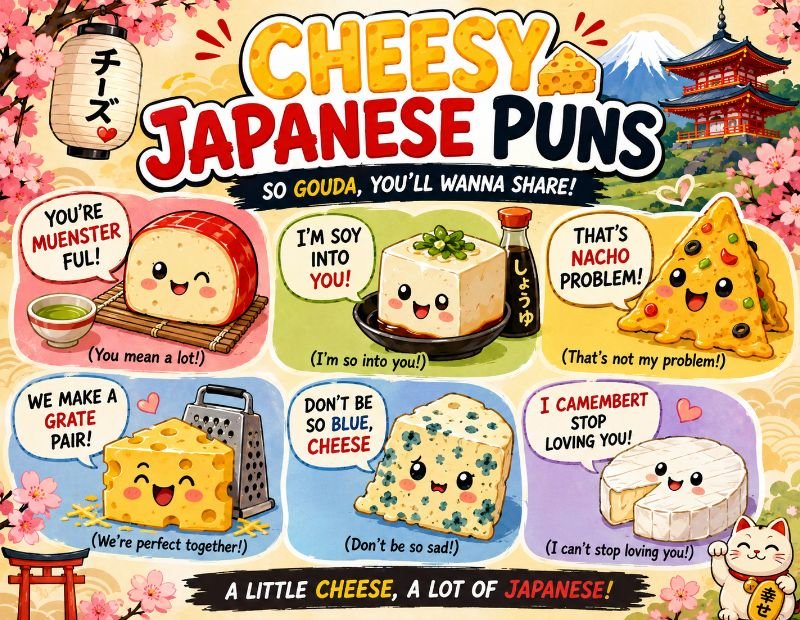
Cheesy puns are warm and silly. They are best used on friends and family who love dad jokes.
- You make my heart go doki doki, so I must be in love with a drum.
- I’m sorry for being so ramen tic.
- I think you are tea riffic.
- You are the miso to my soup.
- Let’s roll together, the sushi way.
- You wasabi the best part of my day.
- I’m not a ninja, but I can sneak up and say hi.
- This pun is a little weird, but it is from my heart.
- Hugs and mochi, the perfect pair.
- You are the sakura of my spring.
- Katana be happy, because of you.
- I like you a sushi bit more than yesterday.
Japanese Puns One Liners
One liners are short, sharp and easy to remember. They fit in a text, a note or a quick conversation.
- Rice to meet you.
- Let’s sake it easy.
- Konnichiwa, how are you wasabi today?
- That ramen was noodle bad.
- My favorite anime is the one I’m in right now.
- Tokyo, you are a city of dreams and trains.
- I tried yoga, but my sensei said I was a bit bendy.
- Mochi time, no time to waste.
- Ninjas never say goodbye, they just vanish.
- You had me at konnichiwa.
- Dajare is my favorite sport because I always groan to win.
- Hai, that was a good one.
Japanese Puns for Jokes and Conversation
If you want to tell a joke at a party, start with something short. A pun lands best when you say it with a calm voice and a slightly proud face.
Tips for Telling Dajare
- Say the pun slowly the first time.
- Keep a straight face, because that is part of the style.
- Do not explain it right away.
- If nobody laughs, smile and say it again, a little louder.
- Pair it with a gesture, like a tiny bow.
- Stay friendly. Nobody wants to be teased for a bad pun, and everybody wants to laugh.
Japanese Puns for Adults
Adult humor in dajare is usually light and cheeky rather than rude. Here are a few that stay tasteful while still giving a wink.
- Sake me tonight, said no one at the quiet bar.
- I’m a little tipsy on sake, but my puns are still sharp.
- Coffee first, then I’m a ninja at work.
- Let’s keep the karaoke going until sunrise.
- My boss said I’m on thin ice, so I brought sushi.
- I came for the ramen and stayed for the drama.
- Overtime is the new hobby of salaried samurai.
- I’m in a long term relationship with my futon.
- Nobody is more dramatic than a tired office worker on a Friday.
- Cherry blossoms are pretty, but my inbox is blooming faster.
Japanese Puns for Names
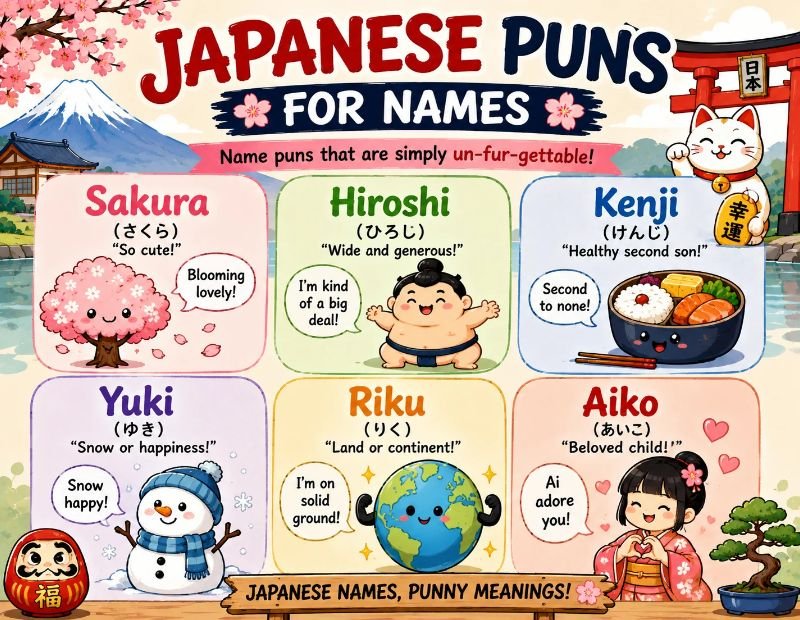
Names with a pun can help a pet, a blog, a business or a gaming account stand out. Here are fun ideas.
Pet Names
- Mochi, for a soft and round friend.
- Wasabi, for a spicy little troublemaker.
- Tofu, for a calm and fluffy pet.
- Ramen, for a curly haired dog.
- Sushi, for a small fish or a cat who loves rolling around.
- Miso, for a warm and friendly buddy.
- Tempura, for a golden and crispy fur color.
- Kimchi Ninja, for a fast cat.
Username and Business Name Ideas
- Pun Samurai
- Dajare Dojo
- Haiku Giggles
- Sushi Roll Comedy
- Kawaii Pun Club
- Ramen Riddles
- Matcha Laughs
- Ninja Noodle
- Ten Thousand Dajare
- Tokyo Giggle House
Japanese Puns for Captions
Good captions are short and playful. Use these for photos of food, travel, pets and fun days out.
Travel and Food Captions
- Just a girl who loves her ramen and her passport.
- Kyoto never looked so good.
- Chasing sakura and good vibes.
- Rolling into the weekend like a sushi chef.
- Good food, good mood, good Tokyo.
- Life is short, so eat the mochi first.
- Tempura tantrum, because dinner was too good.
- Matcha made in heaven.
Social Media Captions
- Dajare of the day: my sense of humor is a little wasabi.
- Futon forever.
- Konnichiwa, Monday, you are not invited.
- I am here for the cute, the quirky and the kawaii.
- Keep calm and eat ramen.
- Sensei says I’m doing fine.
Japanese Puns on Reddit and Online Communities
Online communities love dajare. People share their favorite puns, ask for translations and trade stories about how a joke fell flat at a dinner party. If you search for Japanese puns on Reddit, you will often find threads about language learning, memes and funny mistakes.
What makes these threads popular?
- Learners enjoy the sense of discovery when a pun finally makes sense.
- Native speakers love to explain why a pun is good or bad.
- People share mistaken meanings that lead to extra laughs.
- Anime and manga fans point out wordplay in their favorite shows.
If you join a discussion, be kind and curious. Puns can be fragile, and a good community helps them shine.
Japanese Puns for Language Learners
Dajare are more than comedy. They are a fantastic study tool.
How Puns Help You Learn
- They train your ear to hear small sound differences.
- They make new words stick in your memory.
- They teach you about homophones and kanji readings.
- They give you a fun way to talk with native speakers.
- They help you notice how Japanese uses repetition for rhythm.
Simple Steps to Start Using Dajare
- Learn a few classic puns by heart.
- Practice the sounds slowly, then speed up.
- Try to find the repeated sound in each sentence.
- Make your own pun using a word you just learned.
- Test it with a friend who is patient and kind.
Types of Japanese Puns at a Glance
This table sums up the main styles you will meet.
| Type | How It Works | Example |
|---|---|---|
| Homophone pun | Same sound, different meaning | Kaeru ga kaeru |
| Repeated sound pun | A sound appears twice in a row | Futon ga futtonda |
| Hidden phrase pun | A second phrase hides inside | Toire ni ittoire |
| Loanword mix | Japanese and English combine | Miso love you |
| Food pun | A dish name doubles as a word | Ikura wa ikura |
| Animal pun | An animal name carries a second meaning | Iruka wa iruka |
A Short History of Dajare
Wordplay has been part of Japanese culture for centuries. Poets once used clever language to impress court nobles. When that humor spread to the general public, it was seen as less refined, and the name dajare was born.
Over time, dajare became a gentle comedy form. In the Showa era, they were often seen as clever. In modern times, they are famous for being so bad that they become good. They appear in advertising, television, school life and office conversations.
Fun Facts About Japanese Puns
- Many companies use puns in product names and slogans.
- Teachers use dajare to help students remember difficult words.
- Some phone apps and websites are designed just for pun lovers.
- Dajare are common in classroom jokes, family dinners and workplace small talk.
- Even researchers study how computers can generate puns.
How to Create Your Own Japanese Puns
Making your own dajare is simple if you follow a process.
Step by Step Method
- Pick a simple word, like a food or an animal.
- Say the word out loud several times.
- List other words that sound the same or almost the same.
- Build a short sentence that uses both words together.
- Read it aloud and check the rhythm.
- Keep it short, because short puns are easier to enjoy.
Example of the Method
Start with the word kaki, which can mean persimmon or oyster, depending on the characters used. Both words are food, so you can play with the shared sound and let the listener guess which one you mean. The more surprising the swap, the bigger the groan.
Common Mistakes When Using Japanese Puns
- Explaining the pun too quickly, which kills the mood.
- Using a pun that depends on a very rare word.
- Forgetting to say the sounds clearly.
- Telling a pun in a serious or formal setting without reading the room.
- Giving up after one groan. Real dajare fans never quit.
Where to Use Japanese Puns?
- In a family group chat.
- On a birthday card for a friend who loves Japan.
- At a restaurant when ordering ramen or sushi.
- In a classroom to make vocabulary stick.
- On social media as a caption.
- In a speech to start with a smile.
- In a language exchange to build friendship.
Frequently Asked Questions
What are Japanese puns called?
Japanese puns are called dajare (駄洒落). They are also known as oyaji gyagu, or old man gags.
What is the most famous Japanese pun?
The most famous one is Futon ga futtonda, which means the futon blew away. It repeats the sound fu to create a funny rhythm.
Why do Japanese people groan at puns?
The groan is part of the game. Dajare are meant to be silly and a little bad, so a groan means the pun worked.
Are Japanese puns funny for beginners?
Yes. Many dajare use simple words, which makes them perfect for early learners who want to enjoy the language.
Can I use Japanese puns in English?
Yes. You can create hybrid puns by mixing Japanese words with English sounds, such as miso love you or you are my matcha.
What is the difference between dajare and English puns?
Dajare rely mostly on sound similarity and repeated sounds, while English puns often play with double meanings and spelling.
Are Japanese puns appropriate for adults?
Yes, most dajare are light and playful. Adult versions usually focus on work life, drinks and daily frustrations rather than anything rude.
Where can I find more Japanese puns?
You can find them in language learning blogs, online communities, textbooks, comedy shows and conversations with native speakers.
How can I remember Japanese puns easily?
Say them out loud, repeat the sound pattern and link each one to a funny picture in your mind.
Do Japanese puns help with learning the language?
Yes. They strengthen your listening skills, expand your vocabulary and make study sessions more fun.
Conclusion
Japanese puns are more than silly jokes. They are a window into the language, the culture and the way people share laughter. From the famous futon that flew away to the dolphin that may or may not be there, dajare prove that a little sound play can brighten any day.
Start with the classics, try the kawaii and cheesy versions, and use the English hybrids when you want to share a smile with friends. Practice the sounds, keep a straight face, and enjoy the groans that follow. With a few good puns in your pocket, you are ready to make your day, and everyone else’s, a little more extraordinary.