

Every writer repeats the word “pun” sooner or later. You use it in a caption, then again in the next line, and the text starts to feel flat. Good pun alternatives fix that problem fast.
The top results for this topic, from dictionaries and thesaurus pages to phrase explainers, all share one pattern. They give a quick definition, a list of options, and real examples. This guide does the same, but goes deeper. You will find 28 pun alternatives, practical examples, slang, crossword help, and ready phrases like “pardon the pun” and “pun intended.”
What Are Puns Alternatives? Puns Alternatives Meaning?
A pun is a joke built on words that have more than one meaning, or on words that sound alike but mean different things. Dictionaries describe it as a play on words. The term first appeared in English in the mid 1600s.
So puns alternatives are words and phrases that carry the same idea. They describe wordplay, clever double meanings, and sound based humor.
Here are the closest matches:
- Wordplay
- Play on words
- Paronomasia
- Punning
- Double entendre
- Equivoke
- Quip
- Witticism
Each one fits a slightly different mood. “Wordplay” sounds casual. “Paronomasia” sounds scholarly. “Double entendre” often hints at something cheeky. Picking the right one matters, and that is what the rest of this article helps you do.
Read Also This Blog: Common Puns
Purpose of Puns Alternatives
Why do writers swap “pun” for something else? There are four solid reasons.
- Avoid repetition. Search engines and readers both prefer varied language.
- Match the tone. A formal essay needs “paronomasia,” while a tweet needs “wordplay.”
- Add precision. A pun, a double entendre, and a witty one liner are not the same thing.
- Improve SEO. Using related terms helps search engines understand your topic without keyword stuffing.
Puns themselves serve a purpose too. Advertisers use them to make slogans stick. Headline writers use them to grab attention. Teachers use them to make grammar lessons less boring. Comedians use them to get that famous groan.
Characteristics of Puns Alternatives
Not every alternative behaves the same way. Still, most of them share a few traits.
- Double meaning. One word or phrase works in two ways.
- Sound similarity. Many rely on homophones, such as “knight” and “night.”
- Brevity. Wordplay lands best when it is short.
- Surprise. The listener expects one meaning and gets another.
- Context dependence. The joke only works if the audience knows both meanings.
Here is how the main alternatives compare:
| Term | Tone | Best Used In | Key Trait |
|---|---|---|---|
| Wordplay | Casual | Blogs, captions | Broad and flexible |
| Play on words | Neutral | Everyday speech | Plain and clear |
| Paronomasia | Formal | Essays, literary writing | Technical term for puns |
| Double entendre | Cheeky | Comedy, film | Second meaning is often suggestive |
| Quip | Light | Dialogue | Short and witty remark |
| Witticism | Polished | Speeches, columns | Clever, refined humor |
| Equivoke | Rare | Poetry, old texts | Intentional ambiguity |
Effects of Puns Alternatives
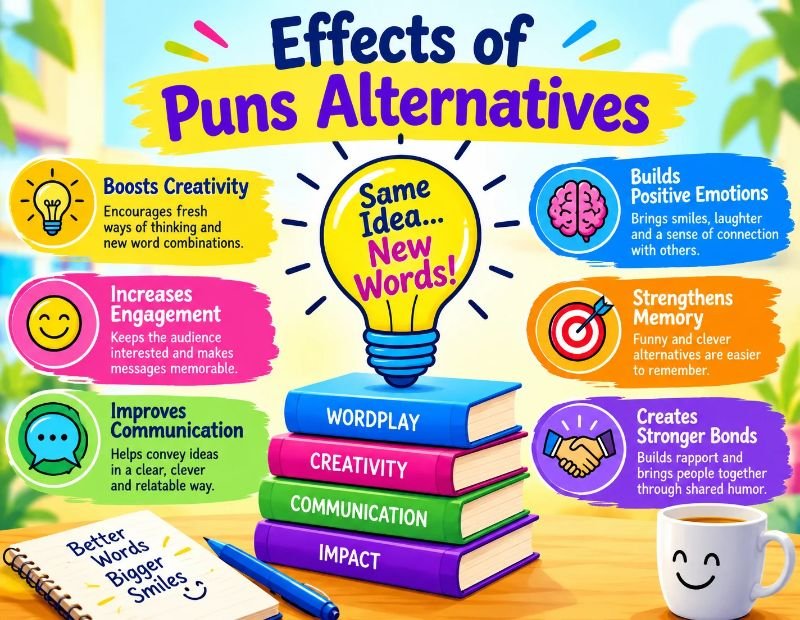
Word choice changes how your sentence feels. Compare these two lines:
- “The ad uses a pun.”
- “The ad relies on a clever double meaning.”
The second line sounds sharper and more informed. That is the effect of a well chosen alternative.
Puns themselves create several effects on an audience:
- Laughter or a groan. Both count as a win.
- Memory. People recall a clever line far longer than a plain one.
- Connection. Sharing a joke builds rapport.
- Brand personality. Playful language makes a business feel human.
- Engagement. Readers stay longer when the writing has some spark.
Overuse has an effect too. Too many puns can make a piece feel forced. One strong line beats five weak ones.
List of 20 Puns Alternatives (Plus 8 Bonus Options)
Here is the full list, grouped by use. Short definitions help you choose fast.
Core Alternatives
- Wordplay: Clever use of words for effect.
- Play on words: The everyday phrase for a pun.
- Paronomasia: The formal, literary name for punning.
- Punning: The act of making puns.
- Double entendre: A phrase with two readings, one often risqué.
- Equivoke: An expression with a deliberate double sense.
- Jeu de mots: The French phrase for wordplay.
- Calembour: Another French term, often used for a pun.
Humor Based Alternatives
- Quip: A short, witty remark.
- Witticism: A clever, amusing saying.
- One liner: A joke delivered in a single sentence.
- Gag: A joke or comic device.
- Crack: A casual word for a joke or wisecrack.
- Wisecrack: A smart, sometimes sarcastic joke.
- Jest: A lighthearted joke.
- Pleasantry: A mild, friendly joke.
Language Based Alternatives
- Homophonic humor: Jokes built on words that sound alike.
- Verbal humor: Comedy based on language.
- Linguistic joke: A joke that depends on how language works.
- Spoonerism: Swapped sounds, as in “a half warmed fish.”
Bonus Pun Alternatives
- Innuendo: A hinted meaning.
- Double meaning: Two possible readings of one phrase.
- Verbal sparring: Playful word battles.
- Linguistic twist: A clever turn of phrase.
- Witty turn of phrase: A neat, memorable expression.
- Pun of speech: A playful rewording of “pun.”
- Play upon words: A slightly older form of “play on words.”
- Verbal jest: A spoken joke built from language.
Types of Puns You Should Know
Understanding pun types helps you pick the right alternative. These categories show up often in language guides.
| Type | How It Works | Example |
|---|---|---|
| Homophonic pun | Words sound the same but differ in meaning | “I’m reading a book on anti gravity. It’s impossible to put down.” |
| Homographic pun | Same spelling, different meanings | “The bakery did well because it made lots of dough.” |
| Compound pun | Several puns in one sentence | “A broken pencil is pointless.” |
| Recursive pun | The joke depends on understanding an earlier one | A pun that references another pun |
| Visual pun | An image carries the double meaning | A drawing of a bee with a “be” speech bubble |
Puns Alternatives Crosswords
Crossword fans search this topic more than you might think. Clue writers love wordplay terms because they fit neatly into grids.
Common answers include:
- PUN (3 letters)
- QUIP (4 letters)
- JEST (4 letters)
- GAG (3 letters)
- WORDPLAY (8 letters)
- PLAYONWORDS (12 letters)
- PARONOMASIA (11 letters)
A tip for solvers: clues containing a question mark usually signal wordplay. If the clue itself looks like a pun, the answer probably is one as well. Count the letters first, then match them against the list above.
Puns Alternatives Slang
Casual speech has its own vocabulary for puns. Some of it is playful, and some is brutally honest.
- Dad joke: A corny, family friendly pun, usually delivered with pride.
- Groaner: A pun so bad that listeners groan.
- Cheesy line: A pun that is sweet but overdone.
- Corny joke: A joke with old fashioned humor.
- Punny: Describes something full of puns.
- Wordsmithing: Crafting clever language.
- Pun fest: A conversation packed with puns.
- Pun off: A friendly contest to see who can make the best pun.
Slang works well on social media, in captions, and in casual blog posts. Avoid it in academic or formal writing.
Visual Puns Alternatives
Not every pun uses words alone. A visual pun uses an image, shape, or design to carry the double meaning. Logos, cartoons, and posters often rely on this trick.
Related terms include:
- Visual wordplay
- Image based pun
- Graphic pun
- Rebus (a puzzle that uses pictures to represent words or syllables)
- Visual gag
- Pictorial joke
A classic example is a logo where the hidden arrow between two letters suggests speed or direction. The viewer smiles when they notice it. That small moment of discovery is the whole point.
Bad Puns Alternatives
Bad puns have a loyal fan base. The worse the pun, the louder the groan, and that groan is half the fun.
Words and phrases for a bad pun:
- Groaner
- Corny pun
- Cringe pun
- Dad joke
- Cheesy wordplay
- Terrible pun
- Eye roller
- Forced pun
Here is a bad pun example: “I used to be a banker, but I lost interest.” It is mild, predictable, and perfectly groan worthy. Another example: “Time flies like an arrow. Fruit flies like a banana.” That one is better than it first seems.
Happy Puns Alternatives
Positive wordplay deserves its own label. Happy puns lift the mood without any sting.
Cheerful options include:
- Lighthearted wordplay
- Playful pun
- Feel good humor
- Cheerful quip
- Merry jest
- Upbeat wordplay
- Sunny one liner
- Wholesome pun
Examples of happy puns:
- “You are a gem, and I mean that in a rock solid way.”
- “Life is short, so smile while you still have teeth.”
- “I’m so glad we met. You make my heart skip a beet.”
These suit birthday cards, greeting messages, school notes, and uplifting social posts.
Pardon Puns Alternatives
“Pardon the pun” is a polite warning. The speaker knows a pun is coming and asks for forgiveness in advance.
You can swap it for any of these:
- Forgive the wordplay
- Excuse the pun
- Pardon the wordplay
- If you will forgive the joke
- Forgive the play on words
- Bear with the pun
- With apologies for the pun
- Forgive my punning
Here is a sample line: “The new bakery is on a roll, pardon the pun.” It sounds friendly and a little self aware. You can use it in articles, speeches, and emails when you want to acknowledge your own cleverness with a smile.
Pun Intended Alternatives
“Pun intended” tells the reader the wordplay was deliberate. It claims credit instead of asking forgiveness. Dictionary examples show it appearing in news writing and reviews all the time.
Other ways to say it include:
- Wordplay intended
- Joke fully intended
- That was on purpose
- Yes, that was deliberate
- Meant as a pun
- Pun absolutely intended
- I did that on purpose
- Playfully intended
Here is a quick comparison of the three main phrases:
| Phrase | Meaning | Typical Feel |
|---|---|---|
| Pun intended | I made this pun on purpose | Proud, playful |
| No pun intended | Claims the pun was accidental | Often ironic |
| Pardon the pun | I know this is a pun, forgive me | Polite, humble |
Interestingly, language references note that “no pun intended” is usually used to draw attention to the pun, so it often works like its opposite. That is part of why the phrase feels so playful.
Excuse the Puns Alternatives

“Excuse the pun” sits close to “pardon the pun,” with a slightly lighter tone. You say it when you slip a joke into a serious sentence.
Useful options:
- Forgive the pun
- Please excuse the wordplay
- Apologies for the pun
- Sorry for the pun
- Pardon my wordplay
- Excuse my punning
- Forgive the groaner
- Don’t mind the pun
Here is an example in a sentence: “Our new coffee blend is a real grind, excuse the pun, but a good one.” Keep these phrases short and place them right after the joke, not before it. Placing the phrase afterward keeps the timing sharp.
How to Choose the Right Pun Alternative?
A thesaurus gives you options. Your audience decides which one works. Use this quick check.
- Know your reader. Casual readers like “wordplay.” Academic readers expect “paronomasia.”
- Check the tone. Playful content welcomes “groaner.” Professional content prefers “witticism.”
- Match the meaning. A “double entendre” is not a general pun. Using it wrongly can embarrass you.
- Read it aloud. If the sentence sounds awkward, swap the term.
- Keep it natural. Never force an alternative in just to look clever.
Quick Substitution Guide
| Instead of | Try | Context |
|---|---|---|
| “a pun” | “a play on words” | Everyday writing |
| “a pun” | “a clever bit of wordplay” | Blogs, reviews |
| “a pun” | “a witty quip” | Speeches |
| “punning” | “paronomasia” | Literary analysis |
| “bad pun” | “groaner” | Social media |
Creative Examples Using Pun Alternatives
Seeing words in action helps most. Here are fresh examples, each using a different alternative.
- Wordplay: “The marathon runner loved his job because it was always a stretch.”
- Play on words: “The electrician’s favorite joke was a real shock.”
- Paronomasia: “The poet’s paronomasia turned a simple farewell into a layered goodbye.”
- Witticism: “She delivered the witticism so smoothly that the room paused, then roared.”
- Quip: “He added a quick quip about the weather being ‘under the weather.’”
- Double entendre: “The film title carried a double entendre that kept viewers guessing.”
- Groaner: “That groaner about the scarecrow winning an award for being outstanding in his field earned a loud sigh.”
- One liner: “I’d tell a chemistry joke, but all the good ones argue.”
Mistakes to Avoid
Even good writers trip over wordplay. Watch for these errors.
- Overusing puns. One or two per piece is plenty.
- Explaining the joke. If you must explain it, it probably failed.
- Mixing up terms. Not every pun is a double entendre.
- Ignoring the audience. Humor that works with friends may fall flat at work.
- Forcing an alternative. Natural language always wins.
Conclusion
Pun alternatives give your writing more range. Words like wordplay, quip, witticism, and paronomasia let you describe humor with accuracy and style. Phrases like “pardon the pun,” “pun intended,” and “excuse the pun” add personality without extra effort.
Start small. Pick two or three terms from this guide and use them in your next caption, post, or article. Match the tone to your audience, keep the wordplay short, and let the humor do the work. That is how a simple word like “pun” becomes a whole toolbox.
Frequently Asked Questions
What is another word for pun?
Common puns alternatives are wordplay, play on words, paronomasia, double entendre, and quip.
What is the formal word for puns alternatives?
The formal literary term is paronomasia, which means a deliberate play on words.
Is a pun the same as a double entendre?
Not exactly. A double entendre has two readings, and one is often suggestive, while a pun can be completely innocent.
What does “pun intended” mean?
It means the speaker made the pun on purpose and wants you to notice it.
What does “no pun intended” mean?
It claims the wordplay was accidental, though people often use it to point out a pun they made deliberately.
What is a good alternative to “pardon the pun”?
Try “excuse the wordplay,” “forgive the pun,” or “bear with the pun.”
What is a slang word for a bad pun?
“Groaner” and “dad joke” are the most popular slang terms.
What is a visual pun?
It is a pun that uses an image or design, rather than words alone, to carry a double meaning.
What crossword answers fit the clue “pun”?
Common answers include WORDPLAY, PLAYONWORDS, QUIP, and PARONOMASIA, depending on the letter count.
Can I use puns alternatives in formal writing?
Yes, but choose precise terms like “wordplay” or “witticism” and keep the tone professional.
How many puns alternatives should I use in one article?
One to three well placed puns usually work best, so the humor feels natural and not forced.