
Ever wondered why some people can drop a perfect pun in the middle of a conversation while others stare at the ceiling for ten minutes? The secret is not luck. Great punsters follow repeatable techniques for puns, and once you know them, wordplay starts to feel natural.
This guide explains what the techniques are, why they work, and how to use them. You will see 15 famous methods, plenty of sentence examples, a step by step writing process, and tips borrowed from the habits of people who pun for fun. Let’s get started.
What Are Techniques for Puns?
Techniques for puns are the specific methods writers and speakers use to create a double meaning that surprises the audience. Each technique gives you a different way to connect two ideas through sound, spelling, meaning, or context.
In simple terms, a pun works when one word or phrase can be read in two ways at once. The techniques are the tools that help you find those two readings and fit them together smoothly.
Most techniques for puns fall into four groups:
- Sound based: the words sound alike or nearly alike (homophones, near rhymes, soundalike phrases)
- Meaning based: one word carries two meanings (homonyms, literal versus figurative use)
- Structure based: the sentence itself is shaped to deliver a twist (setup and punchline, paraprosdokian, Tom Swifty)
- Visual based: the joke lives in an image, spelling, or layout
Understanding these groups makes it easier to pick the right method for the right situation.
Read Also This Blog: Puns and Wordplay
Purpose of Techniques for Puns
Why bother learning techniques for puns at all? Because they turn random inspiration into a reliable skill. Here is what they help you do. Some techniques for puns:
- Create humor on demand. A method beats waiting for a lucky idea.
- Make writing memorable. A clever headline or slogan sticks in the mind.
- Strengthen brand voice. Shop names, taglines, and product pages gain personality.
- Build rapport. A friendly pun breaks the ice in speeches, emails, and meetings.
- Sharpen language skills. Hunting for double meanings grows your vocabulary.
- Add depth to storytelling. A well placed pun can reveal character or mood.
- Boost engagement online. Punny captions and titles often earn more comments and shares.
How to Use the Best Techniques for Puns?
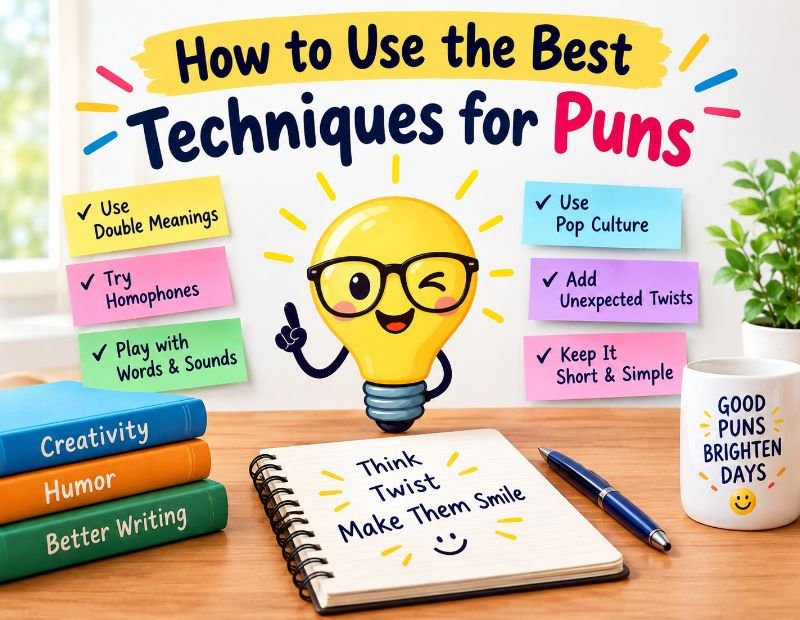
You do not need to use every technique at once. Use the following simple techniques for puns and your results will improve quickly.
Step 1: Know Your Audience and Tone
A pun that works on social media may feel out of place in a formal report. Decide first whether your tone is playful, professional, or somewhere in between. In formal pieces, keep puns rare, and place them in a title or closing line where they feel earned.
Step 2: Choose One Technique
Pick the technique that suits your topic. Food topics are rich in homophones. Tech topics are full of double meaning words like “bug,” “cloud,” and “window.”
Step 3: Test the Pun Aloud
Many puns live in the ear. If it sounds clumsy when spoken, it will likely feel clumsy when read.
Step 4: Keep the Pun Short
The punchline should land quickly. Long explanations kill the moment.
Step 5: Edit Without Mercy
If the pun is obvious, overused, or forced, cut it. A fresh angle always beats a stale one.
15 Famous Techniques for Puns
Here are 15 proven techniques for puns, each with a clear example. Use this table as a quick reference, then read the short notes below.
| # | Techniques for puns | How It Works | Example |
|---|---|---|---|
| 1 | Homophone swap | Replace a word with one that sounds the same | “The chef was fired because he lost his whisk.” (risk) |
| 2 | Homograph play | Same spelling, different meanings | “The nurse said the shot was a minor point.” |
| 3 | Homonym twist | Same sound and spelling, two meanings | “The bat flew out of the cave; the player never saw it.” |
| 4 | List, rhyme, and twist | Build word lists, then swap in a rhyme | “Look before you leap” becomes “Look before you sleep” |
| 5 | Idiom flip | Take a common saying and give it a new meaning | “The gardener has a lot on his plot.” |
| 6 | Literal versus figurative | Treat a figure of speech as literal | “He was feeling blue, so he painted the room.” |
| 7 | Portmanteau | Blend two words into one | “Sheeple” (sheep + people) |
| 8 | Spoonerism | Swap the starting sounds of two words | “You have hissed my mystery lectures.” |
| 9 | Compound pun | Pack several puns into one line | “A well bread baker rolls in dough, kneads no help, and loafs about.” |
| 10 | Tom Swifty | Link an adverb to the speech it describes | “I lost my wallet,” he said pointlessly. |
| 11 | Soundalike sentence | A name or phrase that sounds like a sentence | A place name that sounds like a question |
| 12 | Name pun | Use a person’s or brand’s name as a hook | “Bakers love Kneadlessly Good Bread.” |
| 13 | Paraprosdokian | End with an unexpected twist that changes the meaning | “I told my boss three companies were after me; he asked for the names, so I gave him the tax offices.” |
| 14 | Visual pun | Use an image, symbol, or layout to double the message | A logo where a letter doubles as an object |
| 15 | Bilingual pun | Play across two languages | “The Spanish teacher always says hola to the weekend.” |
1. Homophone Swap
This is the most beginner friendly technique. Take a word that has a soundalike, then build a sentence where the swapped word changes the meaning. Start by listing homophones for your topic word, such as “knead” and “need,” “flour” and “flower,” or “pane” and “pain.”
2. Homograph Play
Homographs are spelled the same but may be pronounced or used differently, like “lead” (a metal) and “lead” (to guide). They work well in written jokes because the reader has to pause and rethink the sentence.
3. Homonym Twist
Homonyms share both spelling and sound, like “bark” (tree) and “bark” (dog). Because the word looks and sounds the same, the surprise comes entirely from context.
4. List, Rhyme, and Twist
This is a classic writer’s process. List words related to your topic, find rhymes for them, search for common phrases that use those rhymes, then replace one word with your topic word. For example, take “spam” and rhyme it with “damned” or “slammed.” You can twist a phrase like “publish and be damned” into “publish and be spammed.” This method is great for headlines.
5. Idiom Flip
Idioms are everywhere, and each one is ready to be reworked. Replace one word with a topic related word. “Barking up the wrong tree” becomes “barking up the wrong tweet” for a social media joke.
6. Literal Versus Figurative
Take a phrase that normally has a figurative meaning and pretend it is literal. “He kicked the bucket” becomes a story about a clumsy janitor. This is a favorite for dad jokes because it needs almost no setup.
7. Portmanteau
Blend two words that share letters or sounds. Brands do this constantly. Try mixing your topic word with a related word, like “yoga” and “bagel” for a cafe joke (“Yogel”), then build a pun around it.
8. Spoonerism
Swap the opening sounds of two words in a phrase. It works best when both versions are real words. Spoonerisms are great in spoken comedy and speeches.
9. Compound Pun
This stacks several puns in one sentence. It is harder, but it earns a bigger reaction when it works. Keep all the puns within one theme, such as baking or music, so the line stays coherent.
10. Tom Swifty
This technique links an adverb to what was said, for example: “I only have one pencil,” said Tom sharply. The adverb carries the pun. It is a good exercise in writing dialogue.
11. Soundalike Sentence
Some names or phrases sound like full sentences when spoken fast. Place names, brand names, and long words are rich sources. Say them aloud in different rhythms and listen for hidden phrases.
12. Name Pun
Names give you instant material. Business names, authors, athletes, and characters can all be twisted. This is why so many salons, bakeries, and cafes have pun based names.
13. Paraprosdokian
Start a sentence in one direction and end it in another. The listener builds an expectation, and the final phrase breaks it. It is less about sound and more about structure.
14. Visual Pun
A visual pun uses a picture or typography to carry the double meaning. Think of a logo where one letter doubles as an object, or a poster where the layout creates a second message. These are common in advertising and graphic design.
15. Bilingual Pun
If you speak two languages, mix them. A word that sounds like another word in a second language can create a clever double meaning. These puns land best with audiences who know both languages.
Techniques for Puns in a Sentence
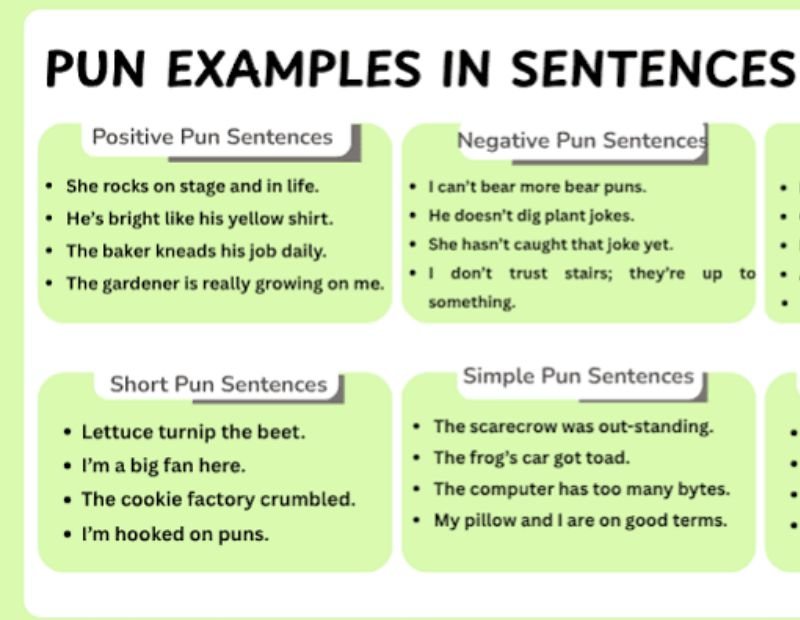
Seeing techniques for puns inside full sentences helps you understand how they work in real writing. Here are original examples.
- Homophone swap: The electrician’s career really sparked after he found his current passion.
- Idiom flip: The farmer’s plans were a bit far fetched, but they were growing on everyone.
- Literal versus figurative: The baker felt under the weather, so he sat inside the oven for warmth.
- Name pun: Our new tea shop is called “Steep Discounts.”
- Tom Swifty: “I need a break,” said the chocolate bar crisply.
- Compound pun: The musician quit because the band was flat, sharp, and out of tune with his future.
- Visual pun description: A bakery sign where the letter O is drawn as a donut.
- Paraprosdokian: I wanted to learn to juggle, but my schedule already has too many balls in the air.
Notice how each sentence sets up an expectation and then changes it in the last few words. That is the key rhythm of a good pun.
Creative Techniques for Puns
Ready to go beyond the basics? These creative methods can make your puns feel fresh.
Use Theme Clustering Techniques For Puns
Pick one theme, such as the ocean, and gather all its words, like wave, tide, current, shell, and drift. Then look for puns that tie them together. Theme based punning gives your content a consistent voice.
Try Reverse Brainstorming Techniques For Puns
Start with a pun idea, like “pasta la vista,” and then write the story or caption around it. Starting with the punchline often leads to better results than hunting for a joke after you have written the setup.
Mine Everyday Phrases Techniques For Puns
Greetings, warnings, and sayings are full of pun potential. Think of “break a leg,” “piece of cake,” “cut corners,” or “cold feet.” Many of them can be flipped to fit a new topic.
Use Technical Jargon Techniques For Puns
Every profession has its own terms with double meanings. A programmer’s “bug,” a pilot’s “landing,” or a chef’s “reduction” can all fuel wordplay. Jargon puns create a smile among people in the same field.
Mix Pop Culture With Your Topic
Add a well known phrase, title, or trend to your topic word. Just make sure the reference is widely known, or the joke will fall flat. Keep it light and avoid copying actual protected lines.
Add a Twist of Timing Techniques For Puns
In speech, a short pause before the punchline makes it more effective. In writing, put the pun at the end of the sentence or in its own line.
Techniques for Puns of Fun
Puns are best when they are fun, so try these are best techniques for puns:
- Pun battles. Two or more people take turns saying puns on a theme. Whoever runs out first loses.
- Caption contests. Pick an image and write the punniest caption you can.
- Pun of the day. Write one pun each morning on a topic from your day.
- Story chains. Each person adds a sentence with at least one pun.
- Rename challenge. Rename everyday items, shops, or pets with puns.
- Word of the week. Choose one word and find as many pun angles as you can.
These games train your brain to spot double meanings quickly, and they are great for classrooms, family dinners, and team meetings.
Techniques for Puns on Reddit
Online communities are great places to learn how people pun. On Reddit, pun focused communities and joke forums usually reward punchlines that are short, clever, and surprising. Writers often ask each other how to build puns, share homophone lists, and swap suggestions for a topic word.
Here is what you can learn from browsing those communities:
- Brevity wins. The best posts have a quick setup and a sharp ending.
- Originality matters. Repeated jokes get downvoted, while fresh angles get praise.
- Context helps. Posters often give a theme or title to prime the reader.
- Feedback is fast. Comments tell you right away what worked and what did not.
- Questions get answers. Beginners asking “how do I make a pun?” often get tools, word lists, and examples from experienced members.
Use these communities as inspiration, but always write your own material rather than copying others.
How to Write Puns With the Best Techniques?
Here is a complete walkthrough: you can follow techniques for puns every time.
Step by Step Techniques For Puns
- Pick a topic word. Choose the main idea of your sentence, such as “coffee.”
- List related words. Write synonyms, associated words, and phrases. For coffee: brew, grind, bean, roast, mug, espresso, latte, drip.
- Find soundalikes. Use a rhyming dictionary or search for homophones. “Roast” can lead to “most,” “toast,” or “post.”
- Search for common phrases. Find idioms and sayings containing those soundalike words. “Roast” and “toast” lead to “the toast of the town.”
- Swap and test. Replace words to see what sounds funny. “The barista was the roast of the town.”
- Refine the sentence. Make the setup clear and keep the twist at the end.
- Read it aloud. Adjust the rhythm until the pun lands naturally.
- Choose the place for it. Use it in a headline, caption, intro, or conclusion, depending on the tone.
Helpful Tools
- Rhyming dictionaries to find similar sounds
- Reverse dictionaries to find words from meanings
- Thesauruses to expand your list of related words
- Phrase and idiom lists to find expressions ready to be twisted
- A notebook or notes app to capture ideas as they come
Writing Habits That Help Techniques For Puns
- Collect words with two meanings whenever you hear them.
- Read comic strips, headlines, and ad slogans to see how professionals pun.
- Practice with clichés, since they are already familiar to readers.
- Invent a character who loves puns and write short scenes with them.
- Learn about grammar quirks and odd spellings, because they offer hidden wordplay.
Good Puns vs Bad Puns
Not every pun is worth keeping. Use this quick comparative techniques for puns to judge your own work.
| Quality | Good Pun | Weak Pun |
|---|---|---|
| Originality | Fresh angle | Overused or obvious |
| Clarity | Easy to understand | Needs explanation |
| Timing | Pun appears at the end | Pun is buried or rushed |
| Fit | Matches topic and tone | Feels forced |
| Reader reaction | Smile or happy groan | Confusion or eye roll |
| Frequency | Used sparingly | Packed into every line |
A weak pun is not a crime, and sometimes a deliberately bad one gets the best groan. But clarity and freshness will always make your wordplay stronger.
Common Mistakes to Avoid When Using Techniques For Puns
- Overusing puns. Too many in one piece makes the tone silly and tiring.
- Explaining the joke. If you have to explain it, it is not working.
- Ignoring the audience. A pun built on slang or culture may confuse some readers.
- Using sensitive topics. Avoid puns on tragedies or painful subjects.
- Forgetting readability. A confusing sentence is never a good pun.
- Copying existing jokes. Always write original material to avoid plagiarism and to keep your voice fresh.
SEO Tips for Using Techniques For Puns in Content
If you write blogs, ads, or product pages, puns can help your content stand out, but they need to work with search intent.
- Put your keyword first. Use the main keyword in the title and the first paragraph.
- Save the pun for a subheading or a caption. Search engines read your page literally.
- Keep headings clear. A pun in an H2 should still tell readers what the section is about.
- Use puns in meta descriptions carefully. A light touch can raise click through rates.
- Match user intent. If readers want facts, keep the tone clear and add wordplay gently.
- Add images and alt text. Visual puns paired with descriptive alt text help engagement and accessibility.
Conclusion
Techniques for puns turn wordplay into a skill anyone can learn. You can start with a simple homophone swap, move on to idiom flips and Tom Swifties, and eventually try compound puns and visual jokes. The key is to practice, read your work aloud, and keep your puns fresh, short, and well timed.
Pick one technique from this list and try it today. Write three puns on a single topic, test them on a friend, and keep the best one. With regular practice, you will soon be the person who always has the perfect pun ready.
Frequently Asked Questions
What are techniques for puns?
They are methods used to create double meanings, such as homophone swaps, idiom flips, portmanteaus, and spoonerisms.
What is the easiest technique for writing puns?
The homophone swap is easiest because you simply replace a word with one that sounds the same.
How do I come up with puns quickly?
Pick a topic word, list related words and soundalikes, then look for common phrases that you can twist.
What is the list, rhyme, and twist method?
You list related words, find rhymes, search for phrases using those rhymes, and swap in your topic word.
What are the main types of puns?
The main types are homophonic, homographic, homonymic, compound, and visual puns.
Why are puns considered funny?
They surprise the brain by showing two meanings at once, which creates a quick moment of delight.
Can puns be used in formal writing?
Yes, but sparingly. A title or closing line is usually the safest place.
What tools help in making puns?
Rhyming dictionaries, reverse dictionaries, thesauruses, and idiom lists are the most useful tools.
How do Reddit communities help with puns?
They offer examples, feedback, and fresh ideas, and they show which puns people enjoy most.
What is a Tom Swifty?
It is a pun where an adverb matches the meaning of the sentence being spoken.
How can I practice pun writing every day?
Write one pun a day on a simple topic, and play word games with friends or family.