
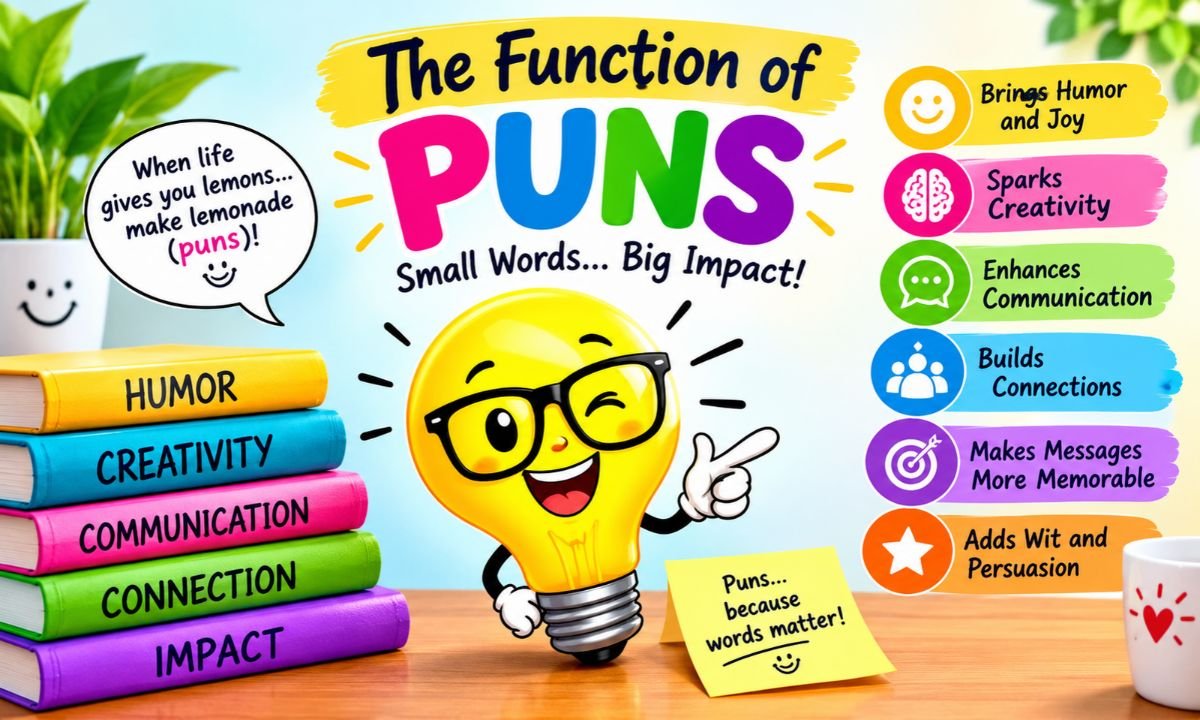
Puns look simple, but they do real work. A single double meaning can make people laugh, grab attention, soften a message, or help a lesson stick.
That is why writers, teachers, comedians, marketers, and everyday speakers keep using them. In this guide, you will learn the main functions of puns, how they work in the brain, how they help in communication, and how to use them for students, kids, adults, and social media.
What Are the Functions of Puns?
The functions of puns are the jobs that wordplay does in language. A pun plays on a word with two meanings, or on two words that sound alike, so the listener must notice both ideas at once.
That small mental twist allows puns to do many things:
- Create humor and a light mood
- Catch and hold attention
- Make a message memorable
- Say something indirectly or politely
- Show wit, creativity, and language skill
- Build a sense of closeness between people
Researchers who study wordplay note that puns serve many discursive functions, including humor and the indirect communication of meaning. In short, a pun is never just a joke. It is a tiny communication tool.
Read Also This Blog: Impact of Puns
Quick Answer for Featured Snippets
The main functions of puns are to entertain, attract attention, improve memory, express ideas creatively, soften serious topics, and strengthen social bonds.
Main Types of Puns
| Type | How It Works | Example |
|---|---|---|
| Homophonic | Words sound alike | “I wondered why the baseball was getting bigger. Then it hit me.” |
| Homographic | One spelling, two meanings | “The bandage was wound around a wound.” |
| Visual | An image carries the double meaning | A drawing of a fish tank with a “Reel Deal” sign |
| Compound | Several puns in one joke | A story ending in two linked twists |
| Recursive | The second pun depends on the first | A joke that refers back to earlier wordplay |
20+ Functions of Puns at a Glance
Here is a quick list before we go deeper.
- Entertain and amuse
- Grab attention
- Improve recall
- Spark creativity
- Break the ice
- Build friendships
- Reduce tension
- Soften awkward truths
- Show wit and intelligence
- Teach vocabulary
- Explain figurative language
- Make lessons engaging
- Support language learning
- Strengthen brand identity
- Boost advertising impact
- Increase social media engagement
- Add depth to literature
- Create character voice in writing
- Show cultural belonging
- Challenge the brain with ambiguity
- Make speeches and toasts memorable
- Add personality to everyday talk
Each one connects to a use case below.
Functions of Puns for the Reader
When you read a pun, you do a little mental work. You first take the obvious meaning, then notice the second one, and then enjoy the click of understanding.
What Readers Gain?
- Enjoyment: The surprise feels rewarding.
- Engagement: A clever line makes people read on.
- Memory: A funny phrase is easier to recall than a plain one.
- Appreciation of language: Readers notice how flexible words can be.
Why Readers Remember Puns?
Studies on Tom Swifty puns found that the punning relationship raised perceived humor and cleverness, and that puns improved memory strength when people focused on the humor. This helps explain why a punny headline or slogan stays in your head.
Functions of Puns for Life
In daily life, puns act like social grease. They make talk smoother, warmer, and more playful.
Everyday Roles of Puns
| Situation | Function of the Pun |
|---|---|
| Meeting new people | Breaks the ice |
| Family dinner | Creates shared laughter |
| Tense moment | Lowers pressure |
| Birthday message | Adds a personal touch |
| Hard conversation | Softens the mood |
Puns also give people a way to say something gently. Psychologists have noted that people sometimes use puns to step around heavier topics, such as emotions or fear of closeness. Used with care, that can ease a conversation.
Functions of Puns for Teachers
Teachers use puns to keep a classroom alert. Humor wakes up attention, and wordplay is quick to prepare.
How Teachers Use Puns?
- Start a lesson with a pun to set a friendly tone.
- Introduce vocabulary by linking a new word to a funny double meaning.
- Teach figurative language through real examples of ambiguity.
- Review key ideas with a pun that sums up the topic.
- Encourage creativity by letting students write their own.
Subject Examples
- Math: “Parallel lines have so much in common. It’s a shame they’ll never meet.”
- Science: “Never trust atoms. They make up everything.”
- Grammar: “I’m reading a book on the history of glue. I can’t put it down.”
A good tip is to explain the double meaning once, so every student can enjoy it.
Functions of Puns for Students
Students benefit from puns in two ways. They learn from them, and they learn by making them.
Learning Benefits
- Better vocabulary, since puns show that one word can carry two meanings
- Stronger reading comprehension, because students must read closely
- Sharper writing, as pun writing trains word choice
- Greater confidence in speaking and presentations
Study Tricks Using Puns
- Turn a hard term into a funny phrase to help recall it.
- Make a pun for each chapter in your notes.
- Share a pun with classmates before a revision session.
For language learners, puns also reveal how sounds and meanings overlap. This builds listening skills and cultural awareness.
Functions of Puns for Kids
Kids love puns because they love silly sounds. As children grow, they discover that a word can mean more than one thing, and puns make that discovery fun.
What Puns Do for Children?
| Function | Result |
|---|---|
| Language play | Vocabulary grows |
| Sound awareness | Reading and spelling improve |
| Humor development | Children learn how jokes work |
| Social bonding | Friendships form through shared laughter |
| Confidence | Kids enjoy making others smile |
Research on dad jokes by psychologists Paul Silvia and Meriel Burnett found that this type of humor rests on puns and wordplay, and that its simple structure makes it accessible across generations. That means a pun can connect a parent and child in a shared moment.
Easy Puns for Kids
- “What do you call a bear with no teeth? A gummy bear.”
- “Why did the banana go to the doctor? It wasn’t peeling well.”
- “What do you call cheese that is not yours? Nacho cheese.”
Functions of Puns for Adults
Adults use puns to relax, bond, and add personality to speech. Puns can also be a polite way to share an opinion without sounding harsh.
Common Adult Uses
- Conversation with friends and colleagues
- Presentations, speeches, and toasts
- Greeting cards and messages
- Product names, slogans, and ads
- Online captions and comments
At work, a light pun can ease a tough meeting. Keep it short, relevant, and kind, and avoid jokes that target a person.
Puns Function in a Sentence
A pun works inside a sentence by building a small trap. The first part leads the reader one way, and a key word turns the meaning.
How a Pun Is Built?
- Setup: The sentence points to the expected meaning.
- Pivot word: One word can be read in two ways.
- Twist: The second meaning appears.
- Payoff: The reader connects both and smiles.
Sentence Examples
| Sentence | Pivot Word | Two Meanings |
|---|---|---|
| “I used to be a banker, but I lost interest.” | interest | curiosity, money earned |
| “The scarecrow won an award because he was outstanding in his field.” | outstanding | excellent, standing outside |
| “I’m reading a book about anti-gravity. It’s impossible to put down.” | put down | stop reading, set down |
The function here is clear. The sentence delivers two messages in one short line.
Functions of Puns in Communication
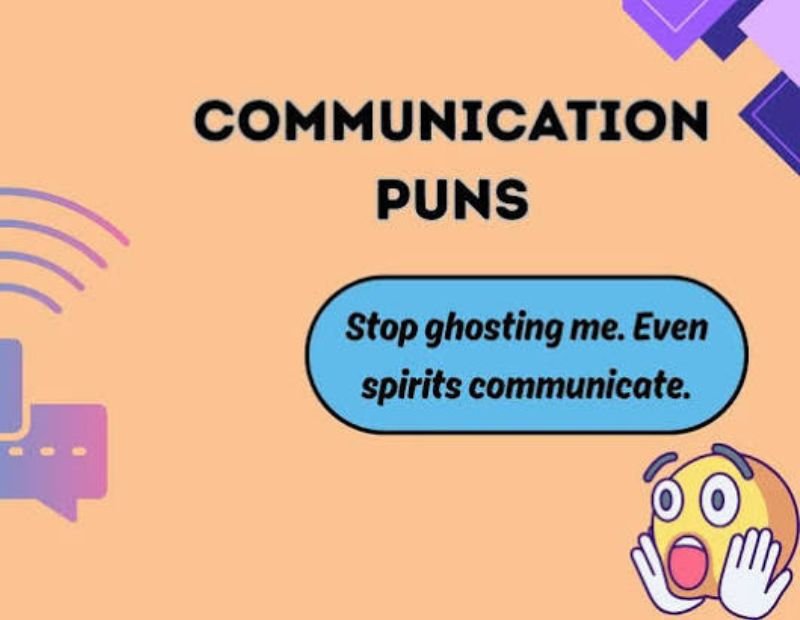
Puns do far more than entertain. In communication, they shape tone, hold attention, and carry hidden meaning.
Key Communication Functions
- Attention: A pun makes people stop and look.
- Tone setting: Wordplay makes a message feel friendly.
- Indirectness: A pun can express a thought gently.
- Brevity: One line can hold two ideas.
- Persuasion: A catchy phrase is easier to repeat and share.
- Identity: Shared puns signal shared humor and culture.
Puns in Advertising and Branding
Brands use puns in slogans, shop names, and product titles. A pun makes a name easier to remember, adds personality, and often earns a smile before the customer reads more.
Puns in Literature
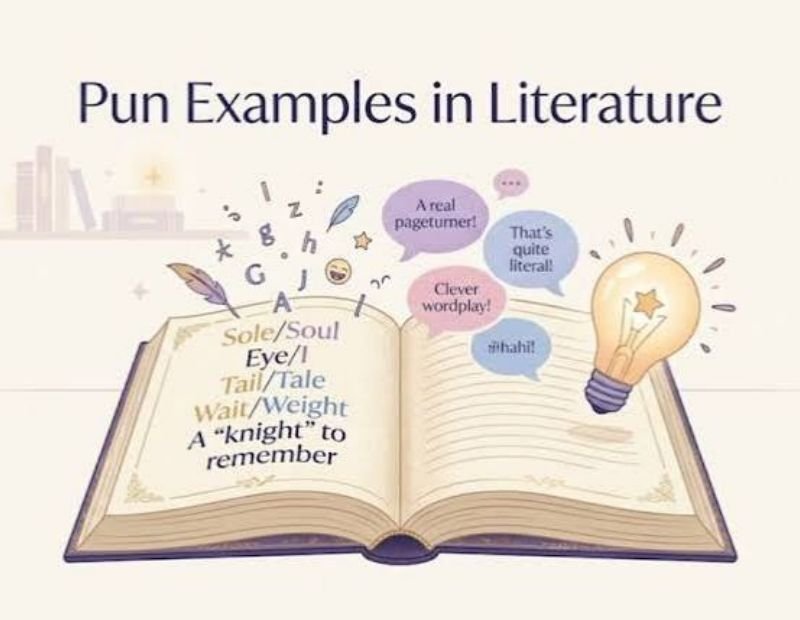
Writers have used puns for centuries to add humor, shape characters, and hide extra meaning. Shakespeare is the best known example, and his plays are packed with wordplay. Studies of literary texts, including work on Alice’s Adventures in Wonderland, show that puns can serve several different purposes inside a story.
Puns Across Cultures
Puns are found in many languages, because homophony and multiple meanings exist almost everywhere. Researchers comparing English and Chinese wordplay have found that culture affects how puns are used, including whether they are seen as a light joke or a respected rhetorical device. This also explains why puns are hard to translate.
Functions of Puns for the Brain
The brain treats a pun like a tiny puzzle. It must notice a clash, resolve it, and then reward itself with amusement.
What Happens Mentally?
- The brain predicts the meaning.
- A pivot word breaks the prediction.
- The brain finds the second meaning.
- A sense of reward follows.
Brain Benefits
- Mental flexibility: Switching between meanings trains quick thinking.
- Language processing: Puns exercise vocabulary and sound awareness.
- Creative linking: Pun making connects unrelated ideas.
- Better mood: Positive feeling from humor may support other thinking tasks.
A 2023 study in Frontiers in Psychology looked at homophone puns and reported that the positive feeling from humor can help ongoing cognitive tasks. Earlier research also links humor with creativity and memory.
Functions of Puns in Psychology
Psychology explains puns through ideas like incongruity, surprise, and social bonding. Each helps explain why wordplay feels good.
Psychological Functions
| Concept | How It Relates to Puns |
|---|---|
| Incongruity and resolution | The joke breaks an expectation, then makes sense |
| Emotional release | Laughter eases stress |
| Social bonding | Shared humor builds closeness |
| Self expression | Puns show personality and wit |
| Coping | Humor can soften heavy feelings |
Are Puns a Sign of Intelligence?
Puns show verbal agility, but they do not directly measure intelligence. Pun skill uses vocabulary, quick thinking, and creativity, which are real strengths, yet intelligence has many forms.
Why Do People Groan at Puns?
The groan is a playful signal. It tells the joker, “I caught that,” while adding a bit of humor to the exchange.
Puns in Literature
On social media, space is short and attention is shorter. Puns fit well because they pack humor and meaning into a few words.
Why Puns Work Online?
- They suit short captions, memes, and comments.
- They make posts easy to remember and share.
- They give a brand a human voice.
- They create catchy hashtags and usernames.
Social Media Pun Ideas
| Niche | Pun Style |
|---|---|
| Food page | “Let’s taco ’bout lunch.” |
| Fitness page | “No pain, no grain.” |
| Pet page | “Pawsitively purrfect.” |
| Travel page | “Let’s get lost in the sun.” |
| Coffee shop | “Espresso yourself.” |
Tips for Using Puns Online
- Keep the pun short and clear.
- Match it to the image or topic.
- Avoid forcing wordplay into every post.
- Check for cultural or offensive meanings.
- Track which pun styles earn the best response.
A fun fact is that a visual pun, such as a picture that matches the wordplay, often works very well on feeds because the image and text support each other.
Techniques for Creating Better Puns
You can learn to make puns with a simple method.
- Choose a topic. Pick something specific, such as coffee, school, or travel.
- List related words. Write terms and phrases connected to the topic.
- Look for sound twins. Find words that sound like your topic words.
- Test double meanings. See if one word can mean two things.
- Build the setup. Lead the reader toward the first meaning.
- Land the twist. End with the second meaning.
- Edit for speed. Cut extra words, since shorter puns hit harder.
Do and Don’t Guide
| Do | Don’t |
|---|---|
| Know your audience | Use puns that may offend |
| Keep it short | Over explain the joke |
| Use fresh ideas | Repeat tired jokes |
| Time it well | Use a pun in every sentence |
Limits and Risks of Puns
Puns are useful, but they have limits.
- Overuse can annoy people.
- Cultural gaps can hide the joke.
- A badly timed pun can feel dismissive in serious moments.
- Translation often breaks the wordplay.
The solution is awareness. Read the room, respect the topic, and keep the tone kind.
Frequently Asked Questions
What are the functions of puns?
Puns entertain, attract attention, aid memory, express ideas creatively, and help people bond through shared humor.
What are the main functions of a pun?
The main function is to create humor by using a word’s double meaning to surprise the listener.
How do functions of puns help in communication?
Puns grab attention, set a friendly tone, and let speakers share ideas indirectly and memorably.
What are the functions of puns for the brain?
Puns train mental flexibility, language processing, and creative thinking by asking the brain to handle two meanings at once.
What are the functions of puns in psychology?
Psychology links puns to incongruity, emotional release, social bonding, and self expression.
How can teachers use functions of puns?
Teachers can use puns to open lessons, teach vocabulary, explain figurative language, and make revision more fun.
Are functions of puns good for students?
Yes. Puns help students build vocabulary, read closely, and remember key ideas.
Are functions of puns good for kids?
Yes. Puns help children learn that words have multiple meanings and support early language skills.
Why are functions of puns used on social media?
Puns are short, catchy, and shareable, so they improve engagement and brand personality.
Are functions of puns a sign of intelligence?
Puns show verbal agility and creativity, but they are not a direct measure of intelligence.
What is an example of a functions of puns in a sentence?
“I used to be a banker, but I lost interest” plays on the two meanings of “interest.”
Conclusion
The functions of puns reach far beyond a quick laugh. Puns grab attention, strengthen memory, spark creativity, ease tension, and bring people closer. They help teachers explain, students learn, kids play with language, adults connect, and brands stand out online.
Try one this week. Add a pun to a caption, a lesson, or a message to a friend. You will quickly see how much a small piece of wordplay can do.