

Not every pun works the same way. Some play on sound, some play on spelling, and some need a picture or a whole story to land. Once you know the types, you can spot wordplay faster, enjoy it more, and write better jokes yourself.
This guide explains the different types of puns, their characteristics, their purpose, and their effects. You will also see examples for readers, teachers, students, kids, and adults, plus how puns work in literature.
What Are the Types of Puns?
The types of puns are the different ways wordplay creates a double meaning. A pun, also called paronomasia, uses words with multiple meanings or similar sounds to create a humorous or rhetorical effect.
Most experts sort puns by what creates the ambiguity. It may be how a word sounds, how it is spelled, or how a phrase is built.
Quick Answer for Featured Snippets
The main types of puns are homophonic, homographic, homonymic, and compound puns. Other common forms include visual, recursive, paronomastic, metonymic, and Tom Swifty puns.
Read Also This Blog: Functions of Puns
Different Types of Puns at a Glance
| Type | What Creates the Double Meaning | Quick Example |
|---|---|---|
| Homophonic | Words that sound alike | “I was struck by how loud the lightning was. It was shocking.” |
| Homographic | Words spelled the same | “I can’t read the rows of a spreadsheet. It’s not my forte.” |
| Homonymic | Words with the same spelling and sound | “I’m reading a book on the history of glue. I can’t put it down.” |
| Compound | Several puns in one line | A joke with two or three twists |
| Visual | An image or layout | A picture of a bee with the caption “Bee yourself” |
| Recursive | One pun depends on another | A pun about puns |
| Paronomastic | Words that sound close, not identical | “A bicycle can’t stand on its own. It’s two tired.” |
| Metonymic | One thing stands for a related thing | “The pen is mightier than the sword.” |
| Tom Swifty | An adverb that matches the speech | “I hate Chinese food,” said Tom disorientedly. |
| Situational | The scene itself creates the pun | A baker who “kneads” the dough |
Characteristics of the Types of Puns
All puns share a few traits, even when their types differ.
- Double meaning: One word or phrase carries two ideas.
- Surprise: The second meaning appears after the first.
- Economy: A good pun is short and sharp.
- Context dependence: The joke needs the right setup to work.
- Intent: Most puns are deliberate, unlike accidental word slips.
What changes from type to type is the trigger. Sound-based puns need to be heard, spelling-based puns need to be read, and visual puns need to be seen.
1. Homophonic Puns
A homophonic pun uses words that sound the same or nearly the same but have different meanings and often different spellings. This is one of the most common types, and it works best when spoken aloud.
Examples
- “I wondered why the baseball kept getting bigger. Then it hit me.”
- “Time flies when you’re having fun. Fruit flies when you throw it.”
- “She had a thing for the sea, so she was in her element near the shore.”
Why It Works
Our brains hear the sound first. A second meaning pops up because another word shares that sound.
2. Homographic Puns
A homographic pun plays on words that are spelled the same but carry different meanings, and sometimes different pronunciations. Because they rely on spelling, they work best in writing.
Examples
- “The farmer was out standing in his field.”
- “When the bass player went fishing, he hit a low note.”
- “The dump was so full they had to refuse more.”
Homographic puns are also called heteronymic puns by some writers.
3. Homonymic Puns
A homonymic pun uses homonyms, which are words with the same spelling and the same sound but different meanings.
Examples
- “I used to be a banker, but I lost interest.”
- “A bicycle can’t stand alone because it is two tired.”
- “The bat flew out of the cave because it was fed up with being hung around.”
Homophonic vs Homographic vs Homonymic
| Feature | Homophonic | Homographic | Homonymic |
|---|---|---|---|
| Sounds alike | Yes | Not always | Yes |
| Spelled alike | No | Yes | Yes |
| Best format | Spoken | Written | Both |
4. Compound Puns
A compound pun stacks two or more puns inside one joke. It can mix homophonic, homographic, and homonymic wordplay.
Example
A classic line from Douglas Adams plays on “tune a” and “tuna,” and then on the word “bass,” which can mean a fish or an instrument. That mix of sound and spelling makes it a strong compound pun.
Why People Enjoy Them
Compound puns reward quick readers. The more layers you catch, the bigger the payoff.
5. Visual Puns
A visual pun uses an image, a layout, or a symbol to deliver the double meaning. You will see them in logos, comics, billboards, and memes.
Examples
- A logo where the letter in a word is replaced by a matching object
- A cartoon of a cat holding a fork with the caption “Fur real”
- A bakery sign shaped like a loaf with the text “Loaf at first sight”
Visual puns suit social media because the image and caption work together in a single glance.
6. Recursive Puns
A recursive pun needs a prior pun or earlier reference to make sense. It rewards people who already know the first joke.
Example
A pun that refers to a previous wordplay joke and then twists it again. These are often shared among friends, forums, or fan groups.
They build insider humor, which makes them popular in online communities.
7. Paronomastic Puns
A paronomastic pun uses words that sound close but are not identical. The listener hears one word and mentally swaps it for another.
Examples
- “Let’s get the ball rolling,” said the bowler enthusiastically.
- “That’s a-moray,” said the eel when asked about love.
- “Can’t you see I’m a-mused?” said the comedian.
These are very common in food, animal, and holiday puns.
8. Metonymic Puns
A metonymic pun uses a word that stands for something connected to it. The double meaning comes from a related object, place, or idea instead of an identical sound.
Examples
- “The crown has spoken.”
- “Wall Street is nervous today.”
These are less about silly sounds and more about clever association.
9. Tom Swifty Puns
A Tom Swifty links an adverb to a line of dialogue so that the adverb matches the meaning in a punny way. The format imitates old adventure books.
Examples
- “I lost my pencil,” said Tom pointlessly.
- “I need a bandage,” said Tom woundedly.
- “I dropped the soap,” said Tom cleanly.
Research on Tom Swifties found that the punning link raised perceived humor and cleverness.
10. Situational and Extended Puns
Some puns need a story or a scene. A situational pun builds a setting where a final word suddenly carries two meanings. An extended pun repeats the wordplay across several sentences.
These are less common in short captions but popular in stand up comedy and storytelling.
11. Spoonerism Puns
A spoonerism swaps the starting sounds of two words, such as turning “light a fire” into “fight a liar.” When the swap creates a funny new meaning, it works like a pun.
They are playful and often used in speech humor.
12. Rhyming Puns
Rhyming puns use a rhyme to carry the twist. They are easy to remember, which is why they appear in greeting cards and slogans.
Examples
- “Don’t be sad, be glad.”
- “You are the cream of my coffee.”
13. Idiom Twist Puns
These puns change a familiar phrase just enough to give it a new meaning.
Examples
- “Let’s not beat around the bush, said the gardener.”
- “The early bird gets the worm, but the second mouse gets the cheese.”
14. Name Puns
Name puns play on a person, place, or brand name. You will see them in shop names, band titles, and nicknames.
Examples
- A hair salon named “Curl Up and Dye”
- A fish and chips shop named “Reel Tasty”
15. Animal and Food Puns
These are not a technical type, but they form a hugely popular category. They combine one of the types above, usually homophonic, with a familiar topic.
Examples
- “You’re one in a melon.”
- “Don’t be koala-fied.”
- “Lettuce celebrate.”
Purpose of the Types of Puns
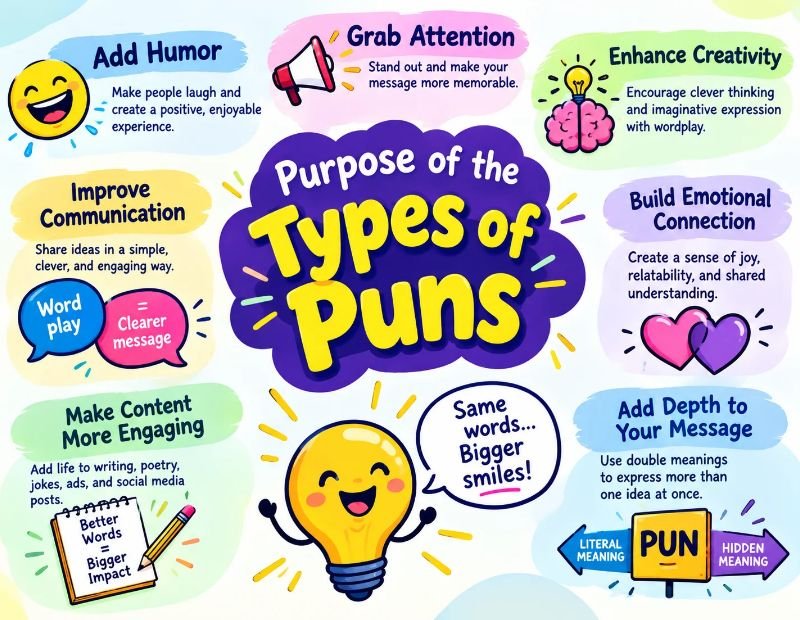
Each type has a goal. Some entertain, some persuade, and some build a sense of belonging.
| Purpose | Types of puns That Fit Best |
|---|---|
| Quick laughs | Homophonic, homonymic |
| Written wit | Homographic, idiom twists |
| Branding and logos | Visual, name puns |
| Insider humor | Recursive, compound |
| Teaching language | Homophonic, homographic |
| Storytelling | Situational, extended |
Beyond humor, puns can underline irony, shape a character, or point out absurdity in a text.
Effects of the Types of Puns
Puns affect people in a few predictable ways.
- Amusement: Surprise triggers a smile or a groan.
- Attention: A clever phrase stops a scroll or a skim.
- Memory: A funny line is easier to recall. Tom Swifty research linked punning relationships with stronger memory when people focused on the humor.
- Mood lift: A 2023 study on homophone puns reported that the positive feeling from humor can support other mental tasks.
- Connection: Shared humor makes people feel closer.
Types of Puns for the Reader
Readers usually meet puns in headlines, captions, books, and ads. Written puns often rely on spelling, so homographic and visual puns do well.
What Readers Enjoy Most?
- Short puns with a clear twist
- Puns that fit the topic
- Wordplay that rewards careful reading
A reader who spots a pun early feels clever, which is part of the fun.
Types of Puns for Teachers
Teachers can match each pun type to a teaching goal.
| Teaching Goal | Pun Type to Use |
|---|---|
| Teach homophones | Homophonic puns |
| Teach multiple meanings | Homographic and homonymic puns |
| Teach grammar | Tom Swifty puns |
| Teach figurative language | Idiom twist and metonymic puns |
| Spark creative writing | Compound and extended puns |
Classroom Examples
- Math: “Why was six afraid of seven? Because seven eight nine.”
- Science: “I would tell you a chemistry pun, but all the good ones argon.”
- English: “I only know twenty six letters of the alphabet. I don’t know y.”
A simple routine works well. Share one pun of the day, ask students to find the double meaning, and then invite them to write one.
Types of Puns for Students
Students learn faster when they work with the puns, not only read them.
Useful Student Activities
- List five homophone pairs and write one pun for each.
- Find a homographic pun in a newspaper headline.
- Rewrite a famous idiom as a pun.
- Create a Tom Swifty using an adverb from the week’s vocabulary.
These tasks build vocabulary, spelling awareness, and creative confidence. For students learning English, puns also show how the same sound can have different meanings.
Types of Puns for Kids
Kids enjoy puns that are short, silly, and based on familiar things like animals and food. Homophonic and homonymic puns work best, because children can hear the sound match.
Easy Kid Friendly Puns
- “What do you call a sleeping dinosaur? A dino snore.”
- “Why did the student eat his homework? The teacher said it was a piece of cake.”
- “What do you call a bear with no ears? B.”
Skills Kids Gain
- New vocabulary
- Sound awareness
- Early reading confidence
- Social bonding through shared laughter
Psychologists who studied dad jokes found that they rest on puns and wordplay, and that their simple pattern makes them easy to enjoy across generations.
Types of Puns for Adults
Adults often prefer layered or subtle puns. Compound, recursive, and metonymic puns suit grown up humor, and so do name puns in business.
Where Adults Use Types of Puns?
- Work chats and presentations
- Toasts and speeches
- Brand names and slogans
- Social media captions
- Dinner table banter
Timing matters. A well placed pun can warm up a meeting, while a forced one can fall flat.
Types of Puns in Literature
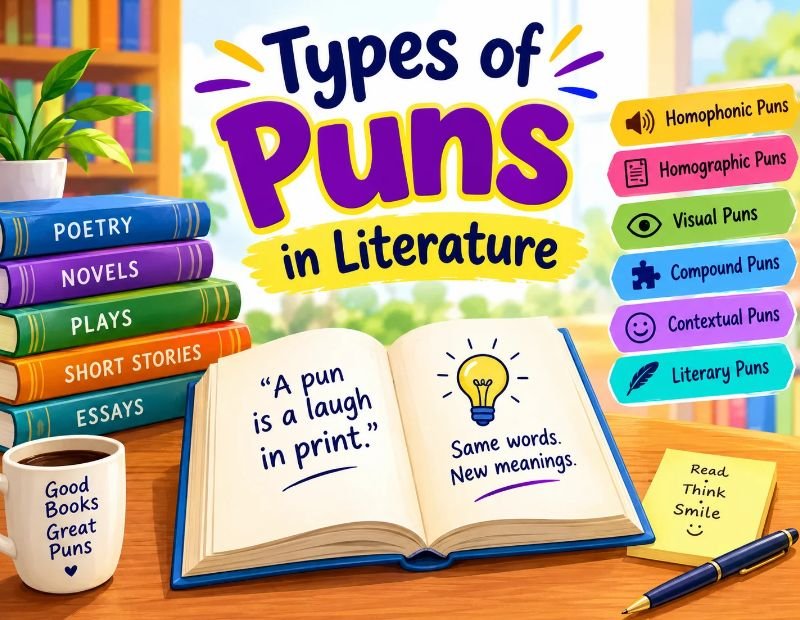
Puns have a long history in writing. In poetry and drama, they add humor, double meanings, and layers of thought. Shakespeare is the most famous example, and many of his plays use wordplay for jokes and for deeper meaning.
How Writers Use Each Types of puns?
| Literary Use | Common Pun Type |
|---|---|
| Comic relief | Homophonic and homonymic |
| Character voice | Tom Swifty and idiom twist |
| Irony and satire | Metonymic and compound |
| Hidden meaning | Homographic |
| Poetic rhythm | Rhyming and paronomastic |
Studies of literary texts, including work on Alice’s Adventures in Wonderland, show that puns can serve several functions in a story, from humor to characterization.
Puns, Double Entendres and Malapropisms
These terms are related but not the same.
- Pun: A deliberate play on two meanings.
- Double entendre: A phrase with two readings, often one of them suggestive.
- Malapropism: An accidental wrong word that sounds like the right one.
How to Choose the Right Types of Puns?
Pick the type that fits your audience and format.
- Spoken setting: Choose homophonic or paronomastic puns.
- Written setting: Choose homographic or idiom twist puns.
- Social media: Choose visual or rhyming puns.
- Classroom: Choose homophonic and Tom Swifty puns.
- Branding: Choose name and visual puns.
- Close friends: Choose recursive or compound puns.
Tips for Writing Better Puns
- Start with a topic and list related words.
- Look for sound twins and words with two meanings.
- Build a setup that points to the first meaning.
- Land the twist at the end of the line.
- Cut extra words so the joke stays sharp.
- Read it aloud to test the rhythm.
Common Mistakes
| Mistake | Better Approach |
|---|---|
| Explaining the joke | Let the reader find the twist |
| Forcing a pun in every line | Use one strong pun |
| Ignoring the audience | Match humor to age and culture |
| Overusing old jokes | Create fresh wordplay |
Frequently Asked Questions
What are the types of puns?
The main types are homophonic, homographic, homonymic, and compound puns, plus visual, recursive, paronomastic, metonymic, and Tom Swifty puns.
What are homophonic types of puns?
A homophonic pun plays on words that sound alike but have different meanings, such as “knight” and “night.”
What are homographic types of puns?
A homographic pun uses words spelled the same but with different meanings, like “bass” the fish and “bass” the instrument.
What are compound types of puns?
A compound pun combines two or more puns inside one joke for extra layers of humor.
What are visual types of puns?
A visual pun uses an image or layout to show a double meaning, as in logos and memes.
What is the purpose of puns?
Puns entertain, grab attention, aid memory, add personality to writing, and help people bond.
What types of puns work best for kids?
Simple homophonic and homonymic puns about animals and food work best because kids can hear the sound match.
Which types of puns are best for teachers?
Homophonic, homographic, and Tom Swifty puns help teachers explain vocabulary, grammar, and multiple meanings.
What are types of puns in literature?
In literature, puns add humor, irony, and hidden meaning, as seen in the plays of Shakespeare.
What is the difference between a pun and a double entendre?
A pun plays on two meanings or sounds, while a double entendre is a phrase with two readings, often one that is suggestive.
What is the difference between a pun and a malapropism?
A pun is deliberate, while a malapropism is an accidental wrong word that sounds like the right one.
Conclusion
Knowing the types of puns makes wordplay easier to enjoy and easier to write. Homophonic puns charm the ear, homographic puns reward the eye, compound puns add layers, and visual puns turn a picture into a joke. Each type has its own purpose, effect, and best audience.
Pick one type, write one pun, and share it today. Whether it earns a laugh or a playful groan, you will see why wordplay has lasted for centuries.