
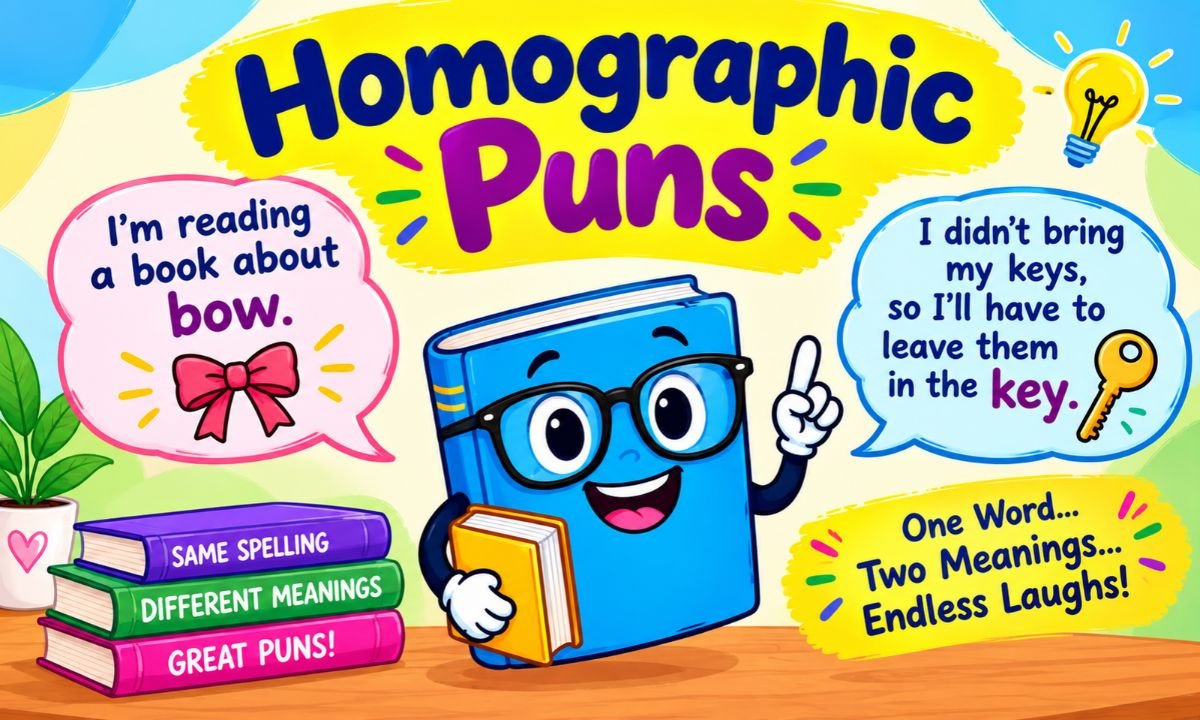
Read this line out loud: “The bandage was wound around the wound.” The same spelling shows up twice, yet the two words sound and mean different things. That small twist is the heart of homographic puns.
Homographic puns turn one written word into two ideas. They live in jokes, headlines, poems, classroom slides, and social media captions. This guide explains what they are, why they work, and how to write your own. You will also find more than 30 examples, audience based pun lists, and a clear look at polysemy, translation, and the difference between homophonic and homographic puns.
Homographic Puns Meanings

A homographic pun is a joke that relies on words spelled the same way but carrying different meanings. The word “homograph” comes from Greek and means “same writing.” So a homographic pun plays on one visible word that can be read in two ways.
Some homographs also change pronunciation. Think of “tear” (to rip) and “tear” (a drop from the eye). Others keep the same sound, like “bat” (the animal) and “bat” (the baseball tool). Both groups can make a pun.
Here is a simple example:
I wanted to be a baseball player, but I couldn’t find the right bat.
If the reader pictures a flying animal for a second, the pun has done its job.
Some scholars call these puns heteronymic puns when the two readings are pronounced differently. In everyday writing, most people just say homographic.
Quick Definition for Featured Snippets
A homographic pun is a form of wordplay that uses a word with identical spelling but two or more meanings, so the sentence can be read in two different ways.
Read Also This Blog: Homophonic Puns
Characteristics Of Homographic Puns
Strong homographic puns share a few features. Once you spot them, you can write them faster.
- Same spelling: The pivot word looks identical in both readings.
- Two clear meanings: Both senses must fit the sentence.
- Sight based humor: The joke usually works best in print.
- Context control: The setup guides the reader toward one meaning before the twist arrives.
- Short delivery: Most good examples are one or two lines.
- A pivot word near the end: The punchline lands better when the double meaning arrives last.
Because the reader has to see the word, homographic puns often shine in captions, riddles, comic strips, and printed jokes.
Purpose Of Homographic Puns
Why do writers choose this kind of wordplay? The reasons go beyond a quick laugh.
- Humor: The classic purpose is to amuse or earn a friendly groan.
- Memory: Double meanings stick in the mind, which is why advertisers love them.
- Emphasis: A pun can underline a theme, such as “close” meaning both near and to shut in a story about a failing friendship.
- Character voice: Witty characters often speak in layered language.
- Engagement: A clever headline can raise clicks and shares.
- Learning: Puns teach vocabulary and show how context shapes meaning.
Writers from Shakespeare to modern stand up comics have used the same trick. It is old, flexible, and still effective.
Effects Of Homographic Puns
A good pun creates several small effects in the reader’s mind.
- A moment of surprise: The first reading breaks and a second one appears.
- A feeling of cleverness: Readers enjoy solving the double meaning.
- Stronger recall: The joke becomes easier to remember and repeat.
- Friendly tone: Shared wordplay builds a sense of closeness.
- Possible eye rolls: Overuse can tire readers, so keep puns purposeful.
Homophonic And Homographic Puns
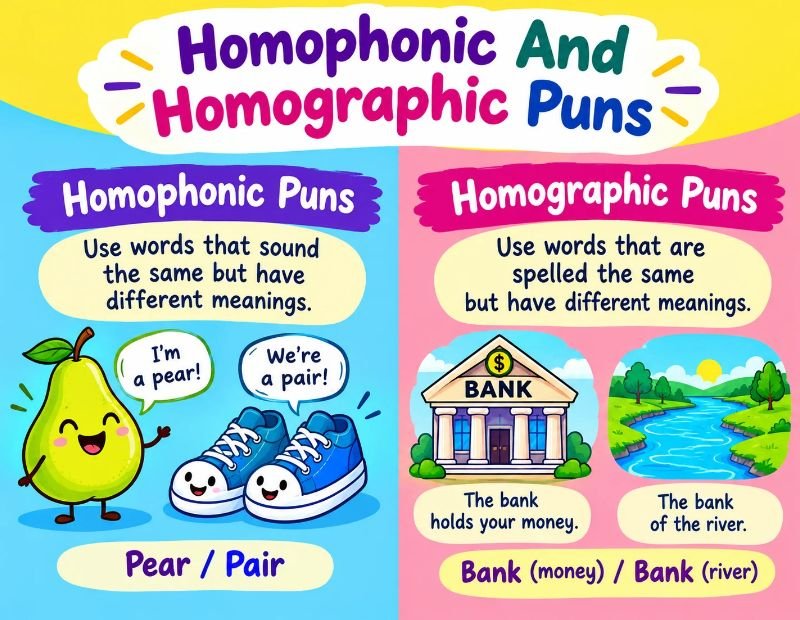
People often mix these two types. The difference is simple. Homophonic puns depend on sound. Homographic puns depend on spelling.
| Feature | Homographic Puns | Homophonic Puns |
|---|---|---|
| Core idea | Same spelling, different meaning | Same sound, different meaning |
| Best format | Written text | Spoken text |
| Spelling | Identical | Usually different |
| Sound | May or may not match | Always matches |
| Example | The bandage was wound around the wound. | Seven ate nine, because “ate” sounds like “eight.” |
| Common places | Captions, riddles, print ads | Stand up, radio, conversation |
Some jokes combine both, and these are called compound puns. A line like “Time flies like an arrow; fruit flies like a banana” plays with the word “flies” in two roles while also leaning on the structure of the sentence.
Homonymic Puns in the Mix
Homonymic puns use words that match in both spelling and sound, such as “bark” for a dog and “bark” for a tree. These overlap with homographic puns, and many writers treat them as a subgroup.
Homographic Puns Polysemy
Polysemy is a useful idea for anyone who writes puns. A polysemous word has several related senses. The word “mouth” can mean the part of the face or the opening of a river. Both senses share a link, so they feel connected.
Homonymy is different. The meanings are unrelated, as with “bat” the animal and “bat” the sports tool. The two words simply share the same spelling by accident of history.
| Concept | Meaning Relationship | Example |
|---|---|---|
| Polysemy | Related senses of one word | “Head” of a person and “head” of a company |
| Homonymy | Unrelated meanings, same form | “Bank” of a river and “bank” for money |
Why does this matter for puns?
- Polysemy puns feel gentle and clever because the link is hidden in plain sight.
- Homonymy puns feel sharp and surprising because the meanings clash.
Some linguists do not separate the two when studying puns, and treat them as one broad group. For writers, the useful lesson is to test whether the reader can connect both senses quickly.
One Word Homographic Puns
Single words can carry a whole joke. These work well for captions, shop names, and short headlines.
- Bank: a financial building or a river edge
- Spring: a season, a coil, or a water source
- Bat: an animal or a sports tool
- Park: a green space or the act of stopping a car
- Light: not heavy or not dark
- Fair: just, or a carnival
- Pitch: a sales talk, a throw, or a sound level
- Row: a line, an argument, or a boat action
- Match: a fire starter or a contest
- Jam: fruit spread or a traffic block
A short, clear pivot word helps the reader catch the joke quickly.
Homographic Puns One Liners

One liners are the easiest way to start. Keep the setup brief and the pivot word near the end.
- Why did the teacher wear sunglasses? Her students were so bright.
- I tried to catch some fog yesterday. I mist.
- The carpenter took a plane to buy a plane.
- The fisherman said he was never in the bank, only on the bank.
- I lost my job at the calendar factory because I took a couple of days off, and my dates were off.
- The sprinter asked the carpenter for help, and the carpenter handed him a bolt.
- Never trust a tree. They bark, and they never mean it.
- The electrician’s favorite news is current events.
- My parking ticket said fine, and I said that was fine.
- The writer had a novel idea for a novel.
Note that a few of these lean on other types of wordplay. They still show how a single word can pull a sentence in two directions.
20 Examples Of Homographic Puns
Here is a quick table of examples you can adapt for posts, slides, and newsletters.
| # | Pun | Pivot Word | Two Meanings |
|---|---|---|---|
| 1 | The bandage was wound around the wound. | wound | wrapped / injury |
| 2 | I object to that object. | object | protest / thing |
| 3 | He could not desert the desert. | desert | abandon / dry land |
| 4 | The farmer had to produce fresh produce. | produce | create / vegetables |
| 5 | The musician loved the bass, and so did the fisherman. | bass | low sound / fish |
| 6 | A tear in my jeans brought a tear to my eye. | tear | rip / teardrop |
| 7 | The author was content with the content. | content | satisfied / material |
| 8 | A minute spider took a minute to spin. | minute | tiny / sixty seconds |
| 9 | The dove dove into the fountain. | dove | bird / jumped |
| 10 | Close the door, you are too close. | close | shut / near |
| 11 | The wind made it hard to wind the clock. | wind | moving air / turn |
| 12 | The lead singer picked up the lead. | lead | guide / heavy metal |
| 13 | The seal asked for a seal of approval. | seal | animal / stamp |
| 14 | The duck had to duck. | duck | bird / dodge |
| 15 | An elephant’s favorite car part is the trunk. | trunk | nose / car storage |
| 16 | The strawberry was late, stuck in a jam. | jam | spread / traffic |
| 17 | The lawyer lost his case, and then his phone case. | case | legal matter / cover |
| 18 | The bank had no interest in my interest. | interest | attention / money charge |
| 19 | I saw the saw and it saw me. | saw | past of see / tool |
| 20 | The ruler of the land lost his ruler. | ruler | leader / measuring tool |
Homographic Puns For Students
Students can learn a lot by spotting pivot words. Puns teach spelling, vocabulary, and the power of context.
- Why was the math book unhappy? It had too many problems to solve and one problem to bear.
- The student wanted a good grade, so he tried to grade the pencils by color.
- The library book was overdue, so it was due for a fine, and the librarian said, “Fine.”
- My history essay was a real period piece, and the teacher added a period to the end.
Study tip: Make a list of ten homographs such as “match,” “park,” and “bark.” Write one sentence for each meaning, then combine them into a pun.
Homographic Puns For Teachers
Teachers can use puns as warm ups, vocabulary boosters, or exit slips.
- The English teacher said she was tired of “close” calls, so she kept the door closed.
- A math teacher never loses patience; she just finds the mean.
- The art teacher loved to draw, even on a draw.
- The music teacher was in a perfect key until the lock jammed.
Classroom ideas:
- Put a “Pun of the Day” on the board.
- Ask students to underline the pivot word.
- Have them write both meanings in two columns.
- Reward the best original pun of the week.
Homographic Puns For Kids
Children enjoy puns that use familiar words and clear pictures.
- What do you call a bat that plays baseball? A very confused animal.
- Why did the pig write a note? It was stuck in a pen.
- Why was the farmer upset? His crop had a stalk, and the stalk was tall.
- What did the clock do at lunch? It went back four seconds.
- Why did the baker stop? He needed a roll, and the dough was on a roll.
For young readers, show a picture of each meaning next to the sentence. Visuals help them catch the joke.
Homographic Puns For Adults
Adults often enjoy drier, more subtle humor, especially around work and daily life.
- My boss told me to table the proposal, so I put it on the table.
- The meeting ran long, so I left it with no minutes, only minutes.
- I asked the bank for a loan, and they showed me their interest in my interest.
- The accountant said she would balance the books, then fell off the bike.
- After a tough quarter, the stock manager was not shocked; he just had too much stock.
Adult puns work best when they feel natural, not forced.
Homographic Food Puns
Food words are full of double meanings, which makes them perfect for menus, blogs, and captions.
- The salad was dressed to impress, but it still needed dressing.
- The baker was on a roll, and so was the bread.
- I asked the chef for a stock tip. He said, “Add more stock.”
- The toast was a great toast at the party.
- The squash player ate squash for lunch.
- The date was sweet, and so was the date.
- The chef was in a pickle, and so was the cucumber.
Homographic Animals Puns
Animal homographs are common and easy to picture.
- The seal needed a seal of approval.
- The duck had to duck.
- The bat lost its bat.
- The mole had a mole on its nose.
- The bird could not swallow another swallow.
- The crane looked up to the crane at the building site.
- The bear could not bear another winter.
- The duck paid its bill with its bill.
Animal themed puns also make excellent material for kids, pet brands, and social posts.
Homographic Festivals Puns
Seasonal words often have two or more meanings, so holidays are a great source of wordplay.
| Festival | Pun | Pivot Word |
|---|---|---|
| Christmas | The best present is simply being present. | present |
| Christmas | The tree was decked out; it had a lot of branches to fill. | branch |
| Halloween | The witch lost her spell and could not spell it. | spell |
| Halloween | The bat’s night out ended with a swing of the bat. | bat |
| Easter | The bunny had a spring in his step on a spring morning. | spring |
| Autumn | The leaves fall in the fall. | fall |
| Diwali | A festival of light, with sweets that are anything but light. | light |
| New Year | My resolution is to improve my phone’s resolution. | resolution |
| Valentine’s Day | He put a ring on it, then gave her a ring. | ring |
Funny Homographic Puns
If you want crowd pleasers, try these.
- Time flies like an arrow; fruit flies like a banana.
- I used to be a baker, but I could not make enough dough, so now I am on a roll.
- The carpenter was good at his job; he really knew how to nail it.
- The skeleton stayed home because he had no body to go with.
- I told a joke about construction, but I am still working on it.
- The tailor was a real pro at suits, but he lost his case.
A good funny pun balances surprise and clarity. If readers need a long explanation, the joke is too heavy.
Homographic Puns On Social Media
Short, visual platforms are made for wordplay. Here is how to use homographic puns well online.
- Use them in captions. A simple pun can lift a plain photo.
- Keep them brief. One or two lines work best.
- Write the pivot word in bold or in caps. This draws the eye to the double meaning.
- Add a matching image. A bat photo beside a bat pun helps the idea land.
- Use hashtags. Try #PunDay or #WordplayWednesday.
- Brand them carefully. A pun that fits your business is more likely to be shared.
Remember that homographic puns are visual. They suit text posts, carousels, memes, and printed graphics better than audio.
Homographic Puns Reddit
Reddit has communities where people share jokes, riddles and wordplay, and vote on the best ones. Reading these threads is a good way to see what modern audiences enjoy. Use them as inspiration for style and timing, but write your own versions instead of copying. Original puns are better for readers, better for credibility, and better for search rankings.
How To Write Your Own Homographic Puns?
You do not need a comedy background. Follow this simple process.
- Choose a topic. Pick a subject, such as cooking, school, or sports.
- List related words. Write ten words that connect to it.
- Find the homographs. For each word, look for a second meaning.
- Write a setup. Build a sentence that leads the reader to meaning one.
- Add the twist. End with the pivot word in meaning two.
- Test with a friend. If you have to explain it, simplify it.
- Trim the extras. Remove any word that does not help the punchline.
Quick tips:
- Use a dictionary to find extra senses of a word.
- Keep the sentence short and the pivot word close to the end.
- Avoid forcing a pun where it does not belong.
- Read the line aloud, even though the pun is written. Rhythm still matters.
How To Translate Homographic Puns In Literature?
Translating a homographic pun is hard, because it depends on one language having a single word that carries two meanings. Another language rarely has the same word with the same two senses. When a translator moves “bank” into another language, the river meaning and the money meaning often split into two different words, and the joke breaks.
Scholars who study wordplay, including Dirk Delabastita, point out that languages divide meaning in different ways. Some critics have even called puns untranslatable. Many translators disagree, and argue that every pun is translatable to some degree, if the translator is flexible about the form.
Before choosing a strategy, a translator should ask:
- Is the pun central to the plot or just decoration?
- What effect does it create: humor, irony, insult or foreshadowing?
- Does the target language have a word with a similar double meaning?
- Who is the audience: children, students or general readers?
Famous authors such as Shakespeare and Lewis Carroll fill their work with puns, which is why their translators face the problem again and again.
Strategies For Translating Homographic Puns
Translation researchers have mapped out a set of common approaches. Here they are in plain language.
| Strategy | What the Translator Does | Works Best When |
|---|---|---|
| Pun to pun | Builds a new pun in the target language | A suitable double meaning exists |
| Pun to non pun | Keeps the meaning but drops the wordplay | The pun is minor |
| Pun to related device | Replaces the pun with rhyme, irony or alliteration | The effect matters more than the form |
| Pun to zero | Leaves the pun out | The pun is not vital |
| Direct copy | Keeps the original pun in the source language | Readers know both languages |
| Non pun to pun | Adds a new pun elsewhere to make up for a loss | The translator wants to keep the tone |
| Zero to pun | Creates a fresh pun where none existed | The text can handle extra humor |
| Editorial technique | Adds a footnote or short explanation | The text is academic or literary |
Studies of subtitles for animated films and series show that translators often replace the pun with plain words in order to protect the meaning, while others create a new pun when the target language allows it. Which approach is best depends on the type of text, the audience, and the time the translator has.
A practical checklist for translators:
- Identify both meanings of the pivot word.
- Decide which meaning is most important to the story.
- Search the target language for words that cover both senses.
- If none exists, choose a related device or add a short note.
- Test the result with native readers.
Many scholars also use Relevance Theory, which suggests that a translator should recreate the same effect on the reader with as little effort as possible. In simple terms, the goal is to make the reader smile in the same places.
SEO Tips For Writing About Homographic Puns
If you run a blog or a business site, puns can help your content stand out. Use these quick tips.
- Use “homographic puns” in your title, intro and at least one subheading.
- Add related terms such as homographs, polysemy, wordplay, double meaning and punchline in a natural way.
- Break content into short sections with clear headings.
- Use tables and bullet lists, because search engines often pull them into featured snippets.
- Answer common questions in one or two lines.
- Add original examples. Copied jokes weaken trust and rankings.
- Link to related pages, such as lists of kids’ jokes or grammar guides.
Frequently Asked Questions
What is a homographic pun?
A homographic pun uses a word with the same spelling but different meanings, so a sentence can be read in two ways.
How is a homographic pun different from a homophonic pun?
Homographic puns depend on spelling, while homophonic puns depend on sound.
Are homographic puns better read or heard?
They usually work better when read, because the spelling is what creates the double meaning.
What is the difference between a homograph and a homonym?
A homograph is any word with the same spelling as another, while a homonym matches in both spelling and sound.
What is polysemy in puns?
Polysemy is when one word has several related meanings, which writers can use to create gentle, clever wordplay.
What are some simple homographic puns for kids?
Try “The duck had to duck” or “The bat lost its bat.”
Can homographic puns be used in advertising?
Yes. Brands use them in slogans and headlines because they are easy to remember and share.
Why are homographic puns hard to translate?
Another language rarely has one word that carries the same two meanings, so the joke often breaks.
What is the best strategy for translating a homographic pun?
There is no single best option; translators may create a new pun, use another device, add a note, or drop the pun.
How can I write better homographic puns?
Pick a topic, list words with two meanings, and end a short sentence with the pivot word.
Conclusion
Homographic puns prove that one small word can carry a lot of meaning. They make readers smile, help ideas stick, and give writers a simple way to add personality to a sentence. Understanding polysemy, homonymy and the link with homophonic puns also makes your wordplay sharper.
Start small. Choose a word with two meanings, build a short setup, and place the pivot word at the end. If you work with translation, remember that the aim is to recreate the smile, not copy every word.
Now try one yourself. Take any example above, twist it into something new, and share it. A good pun is always worth a second read.