

Ever groaned at a joke and smiled at the same time? That is the magic of homophonic puns. They take two words that sound the same, give each a different meaning, and let your brain do the rest.
Homophonic puns show up everywhere. You will find them in classroom jokes, birthday cards, restaurant menus, headlines, tweets, and even Shakespeare. This guide explains what they are, why they work, and how to write your own. You will also get more than 25 examples sorted by audience and theme, plus a look at how translators handle them in other languages, including Mandarin Chinese.
Homophonic Puns Meanings
A homophonic pun is a joke that plays on words that sound alike but mean different things. The word “homophone” comes from Greek and means “same sound.” So a homophonic pun is simply a joke built on the same sound.
Here is a quick example:
I tried to write a poem about a missing puzzle piece, but all I found was a little peace.
The words “piece” and “peace” sound identical. The humor appears when the listener realizes both meanings fit.
Some linguists also call these heterographic puns, because the spellings differ while the sounds match. Others use “homophonic” as the umbrella term for any pun that depends on sound. Either way, the engine is the same: one sound, two meanings.
Read Also This Blog: Nintendo Puns
Homophonic vs Other Types of Puns
It helps to know where homophonic puns sit in the wider pun family.
| Type of Pun | How It Works | Example |
|---|---|---|
| Homophonic | Different words, same sound | “I used to be a banker, but I lost my balance.” (no, see below) |
Let me use a cleaner table instead:
| Type of Pun | How It Works | Example |
|---|---|---|
| Homophonic | Words sound the same, spelled differently | Why was the math book sad? It had too many problems, and it felt blue about its “sum” days (some/sum). |
| Homographic | Same spelling, different meanings | The bandage was wound around the wound. |
| Homonymic | Same spelling and same sound | A bat flew out of the cave, right past the baseball bat. |
| Compound | Mixes several pun types in one line | Time flies like an arrow; fruit flies like a banana. |
Homophonic puns work best out loud. Homographic puns work best on the page. That is why homophonic jokes shine in conversation, stand-up comedy, and radio.
Characteristics Of Homophonic Puns
Good homophonic puns share a few traits. Spot these and you can write them faster.
- Sound match: The two words are pronounced the same, or very close.
- Different spelling: Most homophones are spelled differently, such as “knead” and “need.”
- Double meaning: Both meanings must make sense in the sentence.
- Surprise: The listener expects one meaning, then discovers the second.
- Brevity: The best ones are short, often a single line.
- Context: The setup points toward one meaning while the punchline reveals the other.
A near-homophone, such as “cereal” and “serial,” still counts in casual wordplay. Strict linguists call these paronyms, but comedians rarely care.
Purpose Of Homophonic Puns
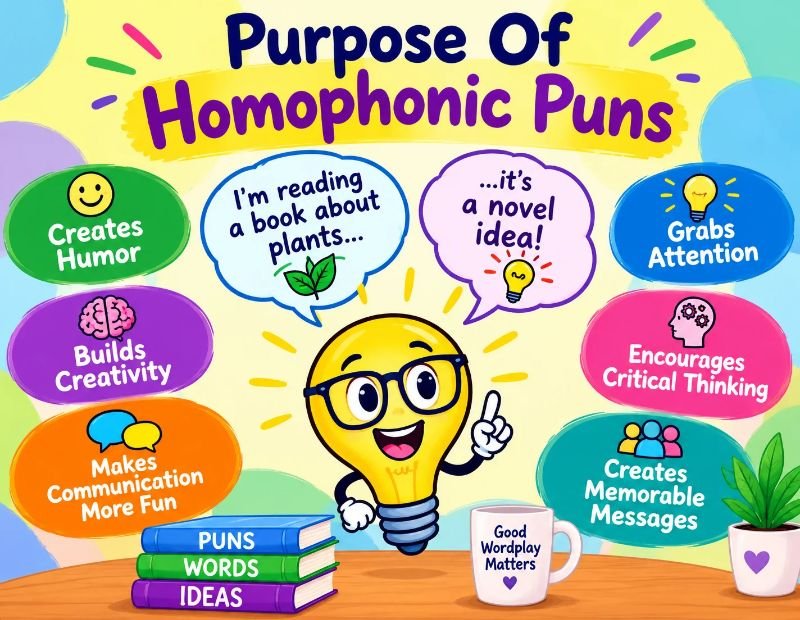
Why do writers and speakers use them? The goals go beyond a quick laugh.
- Humor: The most obvious purpose is to make people smile or groan.
- Memorability: A pun sticks in the mind. Advertisers use this all the time.
- Emphasis: A pun can underline a theme, such as “peace” and “piece” in a story about a broken family.
- Character building: Witty characters often speak in puns.
- Engagement: Headlines with wordplay attract clicks and shares.
- Teaching: Puns help learners notice spelling differences and word meanings.
Shakespeare used puns for drama, insults, and romance. Modern brands use them for slogans. Teachers use them to wake up a sleepy class.
Effects Of Homophonic Puns
A well-placed pun creates several effects at once.
- Laughter or the classic groan: A groan is a compliment. It means the joke landed.
- A feeling of cleverness: The listener enjoys “getting it.”
- Stronger recall: People remember puns longer than plain statements.
- Warmth and connection: Shared wordplay builds rapport.
- Irritation, if overused: Too many puns can exhaust readers. Use them with care.
One Word Homophonic Puns
Sometimes a single word does all the work. These are perfect for captions, business names, and hashtags.
- Whine (wine): for a wine bar with complaints on the menu
- Pawsitive (positive): for pet blogs
- Bee-lieve (believe): for honey brands
- Thyme (time): for herb gardens
- Flour power (flower power): for bakeries
- Sole mate (soul mate): for shoe shops
- Hoarse (horse): for any joke about a tired voice
Short wordplay like this works because the reader needs no setup. The sound does the job.
Homophonic Puns One Liners

One liners are the bread and butter of the form. Keep them tight, and put the pun word at the very end so the punchline lands last.
- I was going to tell a joke about a bread maker, but it was too much of a knead.
- The shoemaker did not enjoy his job; he felt it was lacking sole.
- Why did the deer need a loan? It was out of doe.
- A pair of pears walked into a bar; the bartender said, “You make a great pair.”
- The scale was honest about my weight, so I decided not to wait for feedback.
- Don’t let a great dinner go to your waist.
- The cat could not finish the movie because it kept hitting the paws button.
- Why was six scared of seven? Because seven ate nine.
- The cobbler won an award because his work was sole food for the soul.
- Be kind to your dentist; he has a lot of plaque in his schedule, but it is never a problem for his pane.
If a joke needs a long explanation, it is not ready. Trim it until the sound match is clear.
20 Examples Of Homophonic Puns
Here is a quick list you can copy for social posts, newsletters, or classroom slides. Each shows the pun word and its partner.
| # | Pun | Homophone Pair |
|---|---|---|
| 1 | I’m reading a book on the “missing peace.” | peace / piece |
| 2 | The baker’s secret was a lot of knead. | knead / need |
| 3 | The bicycle fell over because it was two tired. | two / too |
| 4 | Whales tell the best tails. | tails / tales |
| 5 | The deer was broke; it had no doe. | doe / dough |
| 6 | The clam hit the gym to build mussels. | mussels / muscles |
| 7 | Hare today, gone tomorrow. | hare / hair |
| 8 | The pig was a boar, or maybe just bored. | boar / bored |
| 9 | The horse sounded hoarse. | hoarse / horse |
| 10 | Seven ate nine. | ate / eight |
| 11 | He was a cereal offender. | cereal / serial |
| 12 | It was a grate day for cheese lovers. | grate / great |
| 13 | I’ll leaf you alone this autumn. | leaf / leave |
| 14 | Our sunny boy is a real sun, I mean son. | sun / son |
| 15 | A good cobbler has plenty of sole. | sole / soul |
| 16 | The prince was full of hot air, the true heir. | heir / air |
| 17 | That is a whole lot of hole digging. | whole / hole |
| 18 | The baker fell for a flower, then opted for flour. | flower / flour |
| 19 | The window repairer feels the pane. | pane / pain |
| 20 | Oh deer, I called my dear a deer. | deer / dear |
Homophonic Puns For Students
Students enjoy puns that connect to school life. They also help with spelling, since each pun forces you to know both versions of the word.
- Why did the student eat his homework? The teacher said it was a piece of cake.
- Pencils are always sharp, but erasers make the better “rubber” (they rub the mistakes away).
- The student wrote “write” on the board and the teacher said, “That’s right.”
- The history exam was a real “hour” of need, not “our.”
Tip for students: make a list of ten common homophones, such as their, there, and they’re. Then try to build one pun for each.
Homophonic Puns For Teachers
Teachers can use puns as warm-ups, bell ringers, or exit tickets. A pun on the board can help a class remember a rule.
- Grammar teachers know how to be “pro-noun” about it.
- I would tell you a joke about grammar, but I would hate to be too “vowel.”
- The art teacher said the best paintings are a “pane” worth enduring.
- A math teacher’s favorite dessert is “pi,” because it never ends.
Classroom ideas:
- Display a “Pun of the Day” on the board.
- Ask students to underline the homophone pair.
- Have students write their own pun for extra credit.
Homophonic Puns For Kids
Kids love puns that are short, silly, and clear. Keep the vocabulary simple.
- What do you call a bear with no teeth? A gummy bear, and it looks so bare.
- Why did the cookie go to the doctor? It felt crumby.
- What did the ocean say to the beach? Nothing, it just waved (the wave/ waive joke).
- Why do bees have sticky hair? They use honeycombs.
- Why can’t you tell a secret on a farm? The corn has ears.
Kids’ puns work best when children can say them aloud. Read them with a big pause before the last word.
Homophonic Puns For Adults
Adults often prefer dry wit, workplace humor, or a slightly cheeky tone.
- My boss told me to “bear” with him, so I took a long look at the “bare” facts.
- Our quarterly meeting was a real “pane” in the glass, if you know what I mean.
- I am on a seafood diet; I see food and I “sea” it, then I regret it.
- He told me his calendar was full, so I asked for a “date” (the fruit).
- The accountant’s retirement party was a real “balance” of cake and sorrow.
Adult puns can be subtle. The best ones reward a quick second read.
Homophonic Food Puns
Food is a goldmine for wordplay. Many ingredient names have easy sound twins.
- A baker’s life is all about the “dough” and the “doe.”
- Thyme flies when you are cooking.
- Lettuce celebrate with a big salad (lettuce / let us).
- You are “beet-ing” yourself up over that recipe (beet / beat).
- Cheese lovers say life is “grate.”
- The chef was “roll-ing” in dough because he got the lead “role.”
- Mussels flex at the seafood buffet.
These are great for menus, food blogs, and Instagram captions.
Homophonic Animals Puns
Animal homophones are everywhere, and they travel well from kids to adults.
- The bear was cold because it was too bare.
- A fox in a hole is a fur-ious sight (fur / fir).
- The hare on my head is a lot like the one in the forest.
- A moose said “I’m so hoarse,” but really it was a horse.
- The whale was a great storyteller, with a lot of tails.
- The sheep felt “ewe-nique” (ewe / you).
Homophonic Festivals Puns
Holidays offer rich pun territory, because many seasonal words have sound twins.
| Festival | Pun | Pair |
|---|---|---|
| Christmas | Why was it called Noel? Because there was “no L.” | Noel / no L |
| Christmas | Yule be glad you came. | Yule / you’ll |
| Halloween | Which witch is which? | witch / which |
| Halloween | The ghouls scored a goal. | ghoul / goal |
| Easter | Easter egg jokes are a real yolk. | yolk / joke |
| Valentine’s Day | Bee mine. | bee / be |
| Valentine’s Day | You are one in a melon. | melon / million |
| Autumn | I’ll leaf you with this thought. | leaf / leave |
Chinese New Year and Sound Symbolism
Festival wordplay is not only for jokes. In Mandarin Chinese, sound twins shape real traditions. The word for fish (鱼, yú) sounds like the word for surplus (余, yú). That is why the phrase 年年有余 appears on New Year greetings, and fish is a classic dish on the holiday table. Similarly, 年糕 (niángāo) sounds like a phrase meaning “rising higher each year,” so people eat it for progress and prosperity. Hanging the character 福 upside down plays on two phrases that sound the same, one meaning fortune has arrived. These are cultural, serious uses of homophonic puns, not only comedy.
Funny Homophonic Puns
Want a quick list that always gets a reaction? Try these crowd favorites.
- Why did the scarecrow get promoted? He was outstanding, and also out standing in his field.
- I used to hate facial hair, but then it grew on me.
- The coffee filed a police report. It got mugged.
- I’m friends with 25 letters of the alphabet. I don’t know “y.”
- A bicycle can’t stand alone; it is two tired.
- The skeleton did not attend the party because he had no body to go with.
Note that some of these lean on other pun types, but they all rely on that same quick double take.
Homophonic Puns On Social Media
Short, shareable humor is perfect for social platforms. Here is how to use puns well online.
- Use them in captions. A pun can turn a plain photo into a post people save.
- Make them hashtag friendly. Try #PunDay or #WordplayWednesday.
- Keep them short. Aim for one line, under 150 characters.
- Add an image. A cartoon or a plain background helps the pun stand out.
- Brand them. A pun that fits your business gets repeated.
Short videos help too, because spoken puns land better than written ones. The listener hears the sound match in real time.
Homophonic Puns Reddit
Reddit is a popular place to share and rate wordplay. Communities built around puns and dad jokes let users post original lines, vote on the best ones, and trade groan-worthy replies. Browsing these threads is a good way to see what current audiences find funny. Use it as inspiration only, and always write your own version rather than copying a post. Original puns are better for readers, better for search engines, and better for your reputation.
How To Write Your Own Homophonic Puns?
You do not need to be a comedian. Follow this simple process.
- Pick a topic. Choose a subject such as bread, cats, school, or work.
- List related words. Write down ten words that connect to the topic.
- Find the sound twins. For each word, think of a homophone or near match.
- Build a setup. Write a sentence that points toward one meaning.
- Save the pun for the end. Place the homophone last for the biggest effect.
- Say it aloud. If it sounds right, it probably is.
- Cut the extras. Remove any word that does not help the punchline.
A few more tips:
- Use a rhyming dictionary or homophone list to find twins faster.
- Test your pun on a friend. If you have to explain it, rewrite it.
- Do not force a pun where it does not fit. A forced pun reads as a gimmick.
How To Translate Homophonic Puns In Literature?
Translating wordplay is one of the hardest jobs in language work. A pun relies on the sound of a single language, and that sound rarely survives the trip. When “peace” and “piece” are translated into another language, the sound link usually vanishes, and the joke goes with it.
Translators of Shakespeare, Lewis Carroll, and modern comics all face this problem. Researchers who study the issue describe the gap as a mix of linguistic and cultural limits. Some scholars even argue that puns are untranslatable. Most working translators disagree, and say the pun can often be rebuilt in a new form.
Key questions a translator asks:
- Is the pun central to the plot or just decoration?
- What emotion does it create, such as humor, irony, or insult?
- Does the target language offer a similar sound twin?
- Is the audience a child, a student, or a general reader?
Strategies For Translating Homophonic Puns
Translation scholars, including Dirk Delabastita, have mapped out a set of strategies. Here are the most common ones in plain language.
| Strategy | What the Translator Does | Best Used When |
|---|---|---|
| Pun to pun | Creates a new pun in the target language | A sound twin exists |
| Pun to non pun | Keeps the meaning but drops the wordplay | The pun is minor |
| Pun to related device | Swaps the pun for rhyme, irony, or alliteration | The effect matters more than the form |
| Pun to zero | Leaves the pun out | The text is long and the pun is not vital |
| Direct copy | Keeps the original pun in the source language | The audience knows both languages |
| Added explanation | Adds a footnote or short note | The text is academic or literary |
| Editorial creation | Adds a new pun elsewhere to balance a loss | The translator wants to preserve tone |
Many modern researchers rely on Relevance Theory. It suggests that the translator should aim for the same effect on the reader, using the least effort for the reader. In plain terms, the goal is for the audience to smile in the same places, even if the words change.
A study of subtitled animation found that translators often replace the original pun with different words or phrases, in order to keep the meaning. That is a practical example of the pun to pun and pun to related device approaches in action.
Homophonic Puns In Mandarin Chinese
Mandarin Chinese is a natural home for homophonic wordplay. Many characters share the same syllable, so sound twins are everywhere. The formal term for a pun is 双关语 (shuāngguānyǔ), and homophonic puns are often called 谐音 (xiéyīn).
Some features worth knowing:
- Many sound twins: Mandarin has relatively few distinct syllables, so many words overlap in sound.
- Tones matter: Even a tone change can shift the meaning, which creates both opportunities and traps for translators.
- Symbolic gifts and foods: Apples (苹果, píngguǒ) are linked to peace (平安, píng’ān). Pears are avoided as gifts, because the word sounds like separation (离, lí).
- Lucky numbers: The number eight sounds like the word for fortune, so it is considered lucky.
- Visual art: Fish and bats appear in decorative designs because they sound like surplus and good fortune.
These are not just jokes. They are part of everyday culture. That makes translation even harder, because the translator must explain not only the pun but also the tradition behind it.
Translating Homophonic Puns Transcreation
Transcreation is a creative approach that sits between translation and copywriting. Instead of converting words one to one, the writer recreates the effect of the original in a new language and culture.
This is especially useful for marketing. Imagine a slogan built on “flour” and “flower.” A literal translation would erase the joke. A transcreator would look for a local sound twin, or a different play on words, that gives the same smile.
A simple transcreation workflow:
- Brief: Learn the goal, tone, and audience of the original pun.
- Analyze: Identify the sound twin and both meanings.
- Brainstorm: Create several alternatives in the target language.
- Test: Ask native speakers which one feels natural.
- Check culture: Make sure the new pun does not offend or confuse.
- Polish: Adjust spelling, rhythm, and punctuation.
The result may look nothing like the source, but it works. That is the real measure of a good transcreation.
SEO Tips For Writing About Homophonic Puns
If you run a blog or a business page, puns can help your content stand out. Use these quick tips.
- Include the phrase “homophonic puns” in your title, first paragraph, and at least one subheading.
- Add related terms, such as wordplay, homophones, double meaning, and punchline, naturally.
- Break content into short sections with clear headings.
- Use lists and tables, because search engines often pull them for featured snippets.
- Answer common questions directly, in one or two lines.
- Link to related pages, such as lists of kids’ jokes or grammar guides.
- Add original examples. Copied jokes hurt trust and rankings.
Frequently Asked Questions
What is a homophonic pun?
A homophonic pun is a joke that uses words that sound the same but have different meanings, such as “peace” and “piece.”
What is the difference between homophonic and homographic puns?
Homophonic puns rely on sound, while homographic puns rely on identical spelling with different meanings.
Are homophonic puns better heard or read?
They usually work better when spoken, because the sound match is the heart of the joke.
Why are puns considered the lowest form of humor by some people?
They are quick and simple, which makes them easy to groan at, but a well-built pun still takes real skill.
What are some simple homophonic puns for kids?
Try “Why was six afraid of seven? Because seven ate nine,” or “Whales tell the best tails.”
Can homophonic puns be used in advertising?
Yes. Brands use them in slogans and product names because they are memorable and shareable.
How do you translate homophonic puns?
Translators may create a new pun, replace it with another device, explain it, or drop it, depending on the text.
Why are homophonic puns common in Mandarin Chinese?
Mandarin has many words that share the same sound, so sound twins are easy to find and are built into traditions and greetings.
What is transcreation?
Transcreation is creative translation that recreates the effect of the original text in a new language, rather than copying the words.
How can I write better homophonic puns?
Pick a topic, list related words, find their sound twins, and place the pun at the end of a short line.
Conclusion
Homophonic puns are small, but they carry a lot of power. They make people laugh, help ideas stick, and build a sense of shared cleverness. From classroom jokes to New Year traditions in Mandarin Chinese, sound twins shape the way we speak and celebrate.
If you want to write better puns, start small. Choose a topic, find the sound twins, and keep the punchline at the end. If you work with translation, remember that the aim is to recreate the smile, not to copy the words.
Now it is your turn. Pick one of the examples above, twist it into something original, and share it. After all, a good pun is always worth a second look.